




It’s not too bold a statement to suggest that Jay Neale has seen the inner workings of more agencies than anyone else in the industry.
Over the last quarter of a century, he’s sat in more agency boardrooms, breakout spaces and back offices than he – almost – cares to count.
“I think my claim to fame is that I’ve been inside over a thousand agencies in the UK,” he tells us.
And as the commercial driving force behind agency software Synergist – and founder of Agency Works, its reseller arm, which announced a merger with Synergist earlier this month – that number is very much a work in progress.
Neale joined Synergist as its first salesperson over 24 years ago. Over that time, the Manchester-born software business has spent the better part of three decades quietly becoming the operational backbone for some of the UK’s best-known agencies.
How it started
Synergist’s origins trace back to its founders – Keith White, who remains operationally involved today and is the architect of the system, and Stuart Law, who has since moved on.
The company grew out of an accountancy reseller business, and the product was born when a creative agency client identified that standard accounting software simply wasn’t built for the way agencies worked.
“They came across an opportunity with a creative business that identified that an accounting system didn’t really give them what they wanted from a management and operational point of view,” Neale explains.
The result was a piece of software initially called Studio Master, a DOS-based product that quickly evolved – critically – into something that worked across both Mac and PC at a time when designers and account managers were often on entirely different systems.
Those early days are almost comically far removed from today’s cloud-based world. “When you implemented a system, you went to a client site with the product on a floppy disc,” Neale recalls. “You’d get on the train, go to London, be taken to this dingy server room somewhere and be like, ‘Right, there’s the server. You’ve got to install it on there, then go around the building installing it on everybody’s individual machine.’ It was mad.”
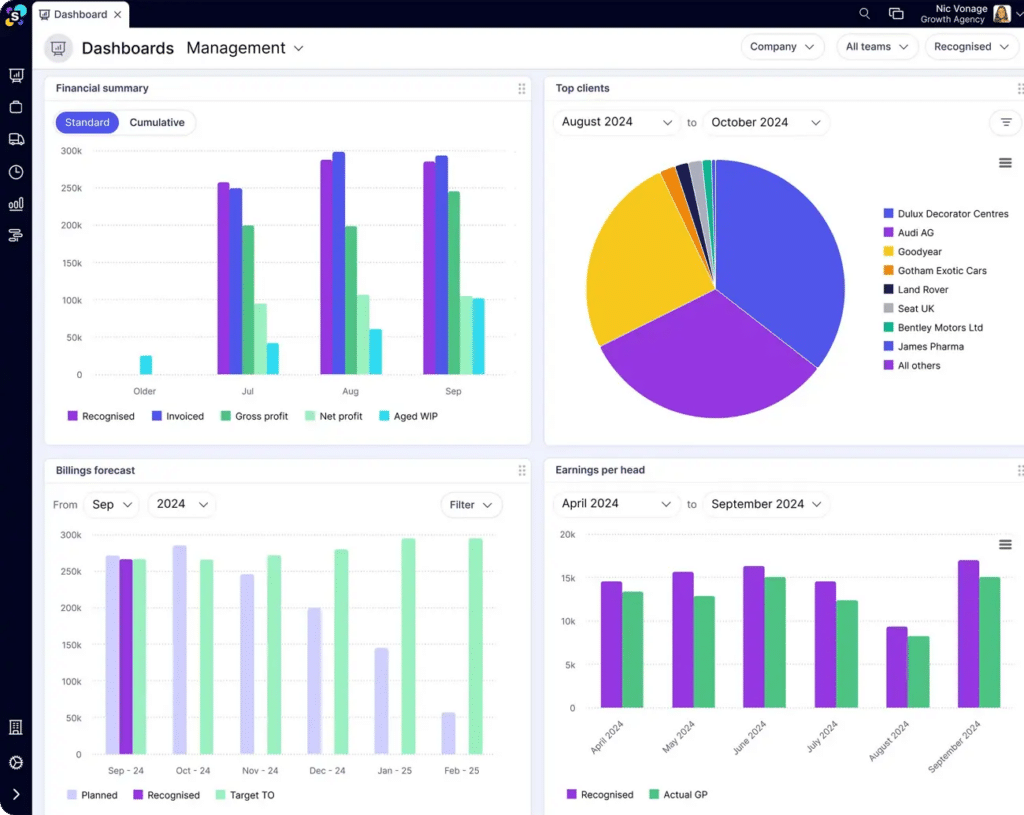
Today, Synergist operates as a comprehensive cloud platform – covering CRM and pipeline management, project management, resource planning, profitability tracking and financial integration with accounting software including Xero, Sage and QuickBooks. The business has around 420 clients and, following the merger, a team of around 40 people.

Given his vantage point, it’s worth listening to Neale on the issues that separate agencies that flourish from those that struggle. It’s not, he argues, primarily about the tools they use.
“In agency world, there are only two real challenges that never change: people and clients. Have you got the right clients, and have you got the right people who can deliver your product and keep those right clients?”
The agencies that handle this well, he believes, share a defining characteristic: clarity of identity. “Their mission is really clear. They know what they are. They don’t try to be something else.” From that foundation, everything else – KPIs, process, data – follows logically.
The agencies that struggle tend to operate in reactive mode, chasing problems that are actually symptoms of deeper structural issues. Take the common complaint of not knowing “what the team is doing”. Neale hears this often, but he’s learned to look beneath it.
“If you stand back, that isn’t the problem. That’s a symptom. The real problem is maybe not understanding what the actual capacity of your agency is.”
He cites an example: ten designers, forty hours each, minus internal time, leaves around 300 billable hours a week. “Are you actually selling 1,250 hours of design time a month? Are you selling more or less? That causes the chaos down the line.”
The ‘wheel of doom’
One key observation Neale makes concerns how agencies respond to losing a major client – and why their instincts so often work against them.
“An agency might lose a client that represents 20% of revenue,” he says. “What they won’t do is say, ‘We’ve lost a million pounds of revenue, we should cut our cloth accordingly.’ What they’ll say is, ‘We’ll replace that client.'”
But replacing a million-pound client with a single equivalent is rare – more often the shortfall is made up by several smaller ones.
And the operational reality is very different: “That one client was probably managed by one person. Now you’ve got several clients, all spending a fraction of that, all wanting the same level of service. So now you need more people to service them. Your costs increase. You end up chasing revenue to cover costs, and that’s when you make bad decisions.”
He calls it “the wheel of doom” – and suggests that going backwards to go forwards, however uncomfortable, is often the more rational choice.
How not to under-recover
Don’t talk to Neale about overservicing.
“I’ve banned that word with my clients,” he says. “Servicing normally means looking after someone. When you use the word ‘over’, it means going beyond to look after them – which for people in the team, could be seen as a good thing. We’re really looking after this client.” He prefers the term “under-recovery”. “To me, we’re under-recovering on a client sounds like we need to do something about it.”
The most common root cause, he argues, is simply that the original quote was too low. Not through laziness, but because of the dynamics of winning work – particularly when you’ve been courting a prospect for a long time and finally get the brief.
“I really want to work with you. I get the brief, do the maths, and it should be 150 hours at £15,000. But I go in at £10,000 because I want the work.”
That commercial decision isn’t inherently wrong, he says – but it needs to be made consciously, communicated internally, and managed accordingly. When it isn’t, teams get blamed for going over budget on work that was never correctly budgeted in the first place.
When asked to distil everything Synergist measures down to a single number, Neale is unequivocal: net profit per job.
“That’s your overriding one – how profitable are my jobs? But that’s almost a lagging indicator. The leading indicators are things like: are jobs running to plan? If you’ve spent 25% of the budget, are you 25% of the way through delivering it?” Managing those leading indicators well, he argues, drives the lagging one. “If you want to move the dial on profitability, those are the things I’d be looking at.”
Who Synergist is actually for
Neale is candid about where Synergist fits best. The sweet spot, he suggests, is agencies from around 10 people upwards, with a gross income of £1.5 million or more – particularly those at an inflection point: thinking about growth, a sale, an employee ownership trust, or simply wanting to step back from day-to-day operations.
“If you’re ten people and you’ve been ten people for ten years and you’re not looking to scale or sell – stay as you are. Don’t give yourself the headache of putting a system in.”
But when there’s an event on the horizon – an exit, a scaling plan, a need to stop carrying everything in your head – process and systems become essential.
Among Synergist’s longest-standing Northern clients are Tangerine, BDB, Uniform and Refinery. Its oldest client relationship dates back to 2003.
Ultimately, the question of Synergist’s suitability for any particular agency is not really about the software.
“It’s the deep understanding of how an agency works,” Neale says. “My team – operations directors, finance managers, founders – they’ve all come from the industry. They’re real operators and practitioners, not people explaining how software works.”
He’s also clear about what Synergist isn’t. “There’s no win-at-all-costs mentality here. We walk away from business if we don’t think it’s right for them and for us.”