


Back in 2024, as the UK entered election mode, Be Broadcast turned the attention of its Mission Control tool, which typically analyses broadcast appearances for clients and brands and pinpoints how they perform against competitors, spots trends, manages issues, and allows a timely response to developing crises, to the world of politics, looking at political voices in the broadcast media and offering a monthly review of “who wins” broadcast throughout the month between prime minsterial hopefuls Rishi Sunak and Keir Starmer.
At the end of August, it returned to the theme with its Who Gets Heard report, looking in depth once again at political voices in the broadcast media.
Since then, we’ve had a party conference season and a new leader for the Greens in Zack Polanski. With all the conferences done and dusted, Be Broadcast has once again risen to the Mission (Control), and in a nutshell things look great for the Greens – and pretty dismal for everyone else.
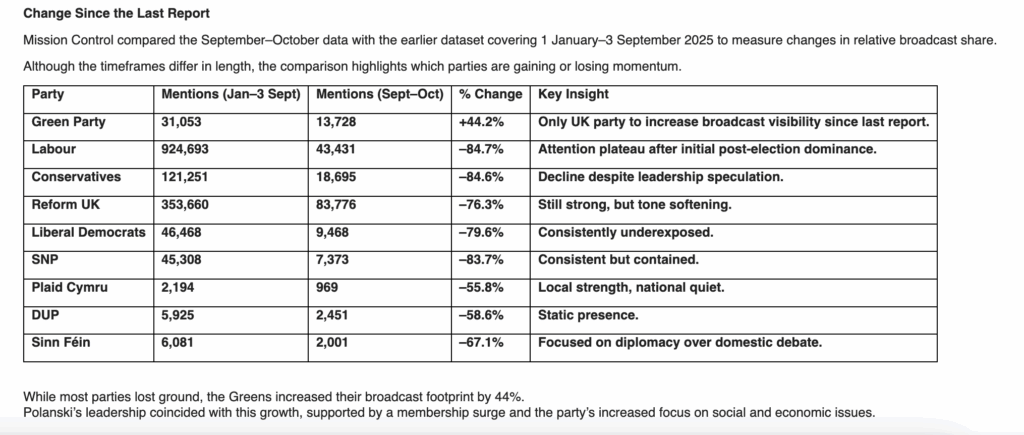
The latest analysis shows the Green Party is the only political force to have grown its broadcast presence, with airtime (mentions, interviews and general discussions) up 44% while every other major party has fallen by as much as 85%.
READ MORE: Dragons’ Den-backed work return platform lends a hand with TPE recruitment
This is the first dataset since Zack Polanski became leader, and his impact appears immediate – mirroring the membership story of the party, which has soared to 126,000 since Polanski took office, overtaking the Conservatives (123,000 as of July 2025) as the third largest political party in the UK by membership behind Labour (333,235 at the end of 2024, the latest figures published, and significantly down on the 500k+ members of the Corbyn era five years ago) and Reform (261,575 according to its own live online ticker).
The new analysis of more than 220,000 UK broadcast mentions shows the Green Party is the only political force to have increased its airtime since early September – with visibility, tone, and membership all rising.
While every other party’s coverage fell by between 55% and 85% during the period, the Greens rose by 44%, the only positive trend recorded.
“Broadcast is often the first indicator of public movement – and that’s exactly what we’re seeing here,” said Josh Wheeler, founder of Manchester-based Be Broadcast. “The Greens’ rise on air mirrors their rise in membership, showing how people are shifting, not just parties.”
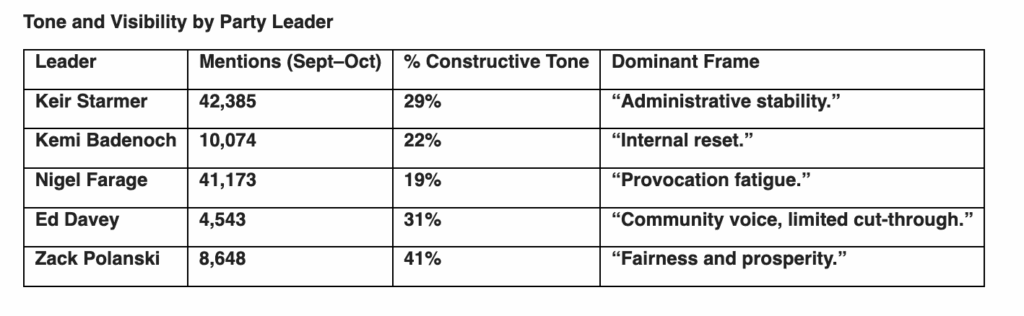
Between 1 September and 20 October, the Green Party achieved 13,728 broadcast mentions, with Polanski personally referenced 8,648 times – more than Liberal Democrat leader Ed Davey (4,543) and close to opposition Leader Kemi Badenoch (10,074). Despite leading a party with only four MPs, Polanski’s media presence now rivals senior figures from the major parties.
Mission Control’s language analysis also shows a distinct tonal shift in how broadcasters discuss the party. Before September, the Greens were primarily framed around protest, climate, and activism; since Polanski’s appointment, that focus has moved to fairness, jobs, prosperity, and the future.
This change has coincided with a dramatic rise in constructive coverage. Some 41% of mentions involving the Greens are now solution-focused or positive in tone – the highest of any national party – compared with 22% for the Conservatives and 19% for Reform UK.
“Audiences respond to clear, consistent communication,” said Tom Hashemi, CEO of policy and strategy specialist Cast From Clay. “Polanski has reframed the Greens’ message from activism to aspiration – jobs, fairness, and prosperity. That’s not the language of protest, it’s the language of ambition.”
The Greens’ per-MP broadcast ratio also now outperforms Labour by more than 30-to-1 and the Conservatives by 22-to-1, a striking change since the last report, although still somewhat behind Reform and its five MPs’ current stranglehold on the broadcast media.

The Green shoots of growth are all the more striking given that this has all come during conference season – a period traditionally dominated by the largest parties, suggesting that the uplift is structural, not seasonal.
“Broadcast acts as a national pulse,” Wheeler added. “When stories about fairness, cost of living, and the future start to dominate airtime, it signals something wider happening in public sentiment.”
Hashemi added: “The same political climate that has opened space for Reform has also opened space for the Greens. People are looking for something different. The question is whether Polanski can convince them that ‘different’ means Green, not Farage.”
While Polanski’s tone is the most positive, other leaders show a different picture. The Conservatives’ constructive tone sits at 22%, suggesting their recent focus on cultural and identity issues has not translated into broader resonance.
“Broadcast rewards clarity and originality,” said Hashemi. “Imitation doesn’t cut through.”
Together, the findings suggest that momentum and message discipline – rather than parliamentary size – are shaping modern broadcast visibility.
In a landscape where every major party except one saw its share of airtime fall “the Greens’ combination of consistency, tone, and public resonance stands out as the clearest measure of political momentum this autumn,” the report added.


