

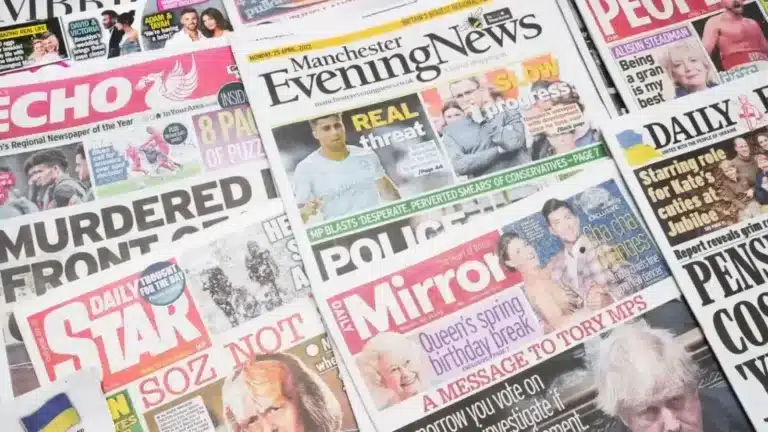

Some of the UK’s biggest regional news brands have suffered dramatic audience declines while a number of Newsquest-owned titles posted significant growth despite a wider downturn across the sector.
Latest IPSOS Iris figures for April show total page views across regional news websites fell 30.4% year-on-year to 525.6m, while unique users dropped 8.6% to 31.9m.
The data reveals sharply contrasting fortunes for the country’s largest publishers. Reach’s flagship regional brands remain the biggest local news websites in the UK, but many recorded substantial audience losses. The Manchester Evening News retained its position as the nation’s largest regional news site with 6.8m monthly users, despite a 27.4% decline year-on-year. Liverpool Echo was down 17.1% to 5.9m users, while Birmingham Mail fell 35.5% to 5.4m.
Elsewhere in the North, the picture was similarly challenging for several Reach titles. Leeds Live saw one of the steepest falls, with its audience dropping 80.5% to 807,085 monthly users, while page views fell 78% to 2.58m. ExaminerLive’s audience was down 58%, LancsLive fell 54.9%, Gazette Live dropped 46.5% and ChronicleLive declined 43.6%.
By contrast, Newsquest continued to post strong growth across a number of its titles. The Herald in Scotland almost doubled its audience, rising 99.1% to 2.93m users, while page views increased 121.5% to 6.5m. Oxford Mail recorded audience growth of 93.4% and Dorset Echo surged 158.2%, making it one of the fastest-growing local news websites in the UK.
Several Newsquest-owned Northern titles also delivered strong performances. The News & Star increased page views by 73.1% to 8.3m and posted the highest engagement score among major regional news brands, with users spending an average of 8.64 minutes on the site. The Lancashire Telegraph increased page views by 52.7% to 3.53m while maintaining strong engagement levels of 2.53 minutes per user.
The Northern Echo saw page views rise by 50.4% to 5.6m despite a modest 5.6% decline in audience, suggesting significantly deeper engagement among readers.
The figures also highlight the continued importance of scale for Reach’s largest brands. Despite substantial audience declines, the Manchester Evening News and Liverpool Echo still generated more than 30m monthly page views each, comfortably ahead of every other regional news site in the UK.
However, with overall regional news consumption continuing to fall and a growing number of Newsquest titles reporting audience and engagement gains, the latest figures suggest the battle for digital readers is increasingly being won through loyalty and depth of engagement rather than sheer reach alone.
In response, Chief Content Officer David Higgerson said: “Reach remains the largest commercial publisher in the UK, and also the largest local news publisher in every market we serve. For example, in Wigan, where the Makerfield by-election is taking place, more people read the Mirror than any other commercial new brand, and the MEN is the best-read local news brand.
“In the latest IPSOS Iris data, it’s important to consider the difference between straight page views and audience, which is where our focus now is. Reach’s audience was down -4.6% year on year. This is among the best performances in the news sector when we compare against the other two big regional publishers as well as several of the nationals, many of which are facing into double-digit audience declines.
“We can see from the data that our loyal audience has remained strong, despite passing or casual traffic falling. Loyal audience is up year on year for key titles, and in-market reach is stable. For example, the MEN continues to reach 50% of people in Manchester and Salford, the same as it did last year. The data also shows that despite viewing fewer pages, our audiences are spending just as much time with us, thanks to our focus on live blogs, which we know engage people for longer, video growth, and the effort that’s going into our Premium content since launching those subscription offerings.
“Like other publishers, we remain deeply concerned about the impact the BBC’s investment in local news is having, providing duplicate services and creating an uneven playing field for publishers who were providing digital news locally long before the BBC considered this a priority. This is now clearly coming through in the audience data every month, and if allowed to continue unfettered, will result in greatly diluted local news coverage across the country, as the BBC has set itself up to focus only on getting scale as quickly as possible, and shown no interest in providing the level of community depth existing commercial news publishers have provided for generations.”