
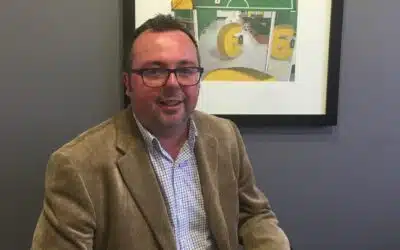


Paul Hadfield is strategy director at BIG Partnership. He joined the agency in 2020 and leads on brand and creative strategy, campaign platforms, messaging frameworks and everything in between.
His role is to help clients make sense of what’s really going on across audiences, behaviours, culture and markets, turning that complexity into clear, commercially effective thinking that works in the real world.
Founded in Glasgow, BIG has evolved significantly in recent years, transitioning from its strong PR heritage into a fully integrated, digital-first brand and communications agency.
Today, it works with a diverse client base including Aldi, the NHS and Morris Homes, as well as Rock Face, Pall Mall Medical, Cumberland Building Society and the Scottish Professional Football League.
Hadfield brings nearly 20 years of industry experience, with previous roles including creative director at Havas, brand-side at TUI, and earlier positions in PR and social at Manchester Airport.
Over the course of his career, he has delivered award-winning campaigns across a wide range of brands from sausage rolls, supermarkets, cereals and pets, to banks, airlines, healthcare and house builders.
From lucky breaks to ‘best’ failures, he shares some of the lessons he’s learnt in his life and career so far…
Which single daily habit or practice could you not do without?
Writing a ‘to do’ list. It sounds basic, but when you’re juggling a lot it’s the difference between feeling organised and feeling like you’re just reacting. It clears your head and lets you crack on with what actually matters. Coffee helps too. And the gym. Ideally, in that order.
What’s been your luckiest break?
I knew for a long time that I wanted to work in advertising. I just didn’t know how to get in. So after college, I did all sorts of jobs along the way – stacking shelves, laying patios, working in call centres and warehouses – while trying to figure it out.
I didn’t expect that path to start in PR. But it did. It wasn’t a calculated move. It was accidental. And it turned out to be a huge stroke of luck.
Looking back, PR gave me an earned-first mindset and taught me early on that communication is about people, not channels. One clear idea can flex in multiple ways, depending on who you’re speaking to, what they care about and the context they’re in. That grounding has stayed with me ever since and feels more relevant now, than ever.
What’s your best failure?
There are plenty. One early lesson was learning that journalists will happily quote you verbatim, even when you think you’re being informal. Seeing “It’s all good in the hood” appear quoted in a national newspaper taught me very quickly that words matter, context matters, and nothing is ever quite as throwaway as you think it is.
More broadly, I’ve learnt that most failures are only failures if you don’t learn from them. If you do, they’re just expensive training.
What is the best investment you’ve ever made, either financial or time?
Time spent experiencing things outside of work. Travel, new places, different people and different perspectives. Seeing things for yourself rather than talking about them in an office. That’s where real understanding comes from. The best ideas rarely come at your desk or in a brainstorm session, alone. They come from life, from people, and from paying attention to what’s really going on around you.
Which podcast or book would you recommend others to read/listen to, and why?
Honestly, my advice would be: don’t just listen to marketing podcasts. Marketing is often a bubble. If you only consume industry content, you end up talking to yourself. The people you’re trying to reach don’t live in that bubble, so neither should your thinking.
If you pushed me to name something, Spotify tells me my most-listened-to podcasts are Talk of the Devils and United We Stand. Which probably says more about my interests than any strategy book ever could. The point is to listen widely, especially to things you wouldn’t normally choose. Often, that’s where real insight comes from.
What one piece of advice would you give your 21-year-old self?
Try everything. Get involved. Ask questions. Stay curious. That’s how you figure out what you’re good at and how the bigger picture fits together. I did, and I’d tell anyone starting out to do the same.
And don’t assume you have to move somewhere else to do meaningful work. Great thinking isn’t concentrated in one city anymore. It’s also happening across Manchester, Glasgow, Leeds, Aberdeen and beyond – because the work speaks for itself.
Finally, have fun. This industry already takes itself seriously enough.
Who or what has had the single biggest influence on your working life?
Two people, at different points.
Russell Craig, formerly comms director at Manchester Airport, gave me a chance early on, and I’ve never forgotten that. He taught me the power of speaking to different people in different ways. There isn’t a single way to communicate. You use whatever tools the job needs – emotion, humour, creativity or clarity. That experience still shapes how I think.
Then Brian Beech, MD at Havas, who also backed and trusted me. He taught me to be yourself and remember that clients don’t buy consultancies, they buy people. Credibility isn’t built on how good the slides look. It’s built on delivering what you say you will on those slides.
Between them, they shaped how I approach everything. Be nice to people. Understand who you’re speaking to. Do the work properly. Back your thinking. Then deliver on it.
Tell us something about you that would surprise people.
I’ve always been comfortable putting myself in uncomfortable rooms, even though I’m naturally reflective rather than loud.
I’m not the stereotype of the big agency strategist. But I back my thinking, I ask the questions others don’t, and I’m comfortable challenging when it matters – including challenging myself.
So whether that was moving away to work at a theme park, taking a secondment to Havas in New York, or stepping into senior roles earlier than I probably felt ready for, I’ve learnt that growth usually happens just outside your comfort zone. Almost every character-forming experience I’ve had taught me the same thing: read the room, understand the people in it, and bring value.
If there was one thing you could change about your career, what would it be and why?
I wish I’d kept a diary from day one. I could absolutely write a book at this point.
This industry lets you do things you’d never normally get to do and meet people you’d never normally get to meet. It’s hard work. It can make you laugh and cry in equal measure, and some days are genuinely ridiculous. But I love the buzz and the hustle of it.
If any publishers fancy The Secret Diary of a Marketing Pro, feel free to get in touch.
What does success look like to you?
For me, success is impact and it’s a feeling more than a status.
It’s seeing the work land. Hearing clients say it made a difference. Knowing it moved something forward commercially.
It’s when mates or family mention a campaign in conversation, especially when they don’t realise what they’re talking about was marketing. That’s when you know it’s genuinely cut through.
You’re only ever as good as your last idea, so recognition is welcome, but it’s fleeting. Real success is consistency, being able to do it again and again.
More broadly, it’s being happy. Doing meaningful things with good people and having experiences along the way.
Everything else is noise.