

HUB Growth Director David Slater asked his network of CMOs and senior marketing leaders one simple question – what are your biggest challenges right now? Their answers revealed a profession under pressure – and six themes that agencies can’t afford to ignore. Prolific North sat down with him to unpack what he learned….
David Slater wasn’t trying to write just another opinion piece.
Determined to add value from real insight, HUB’s Growth Director went directly to the people confronting the pressures of modern marketing leadership every day.
He asked his network of Yorkshire-based CMOs and senior marketers a simple question: what are your top three challenges right now?
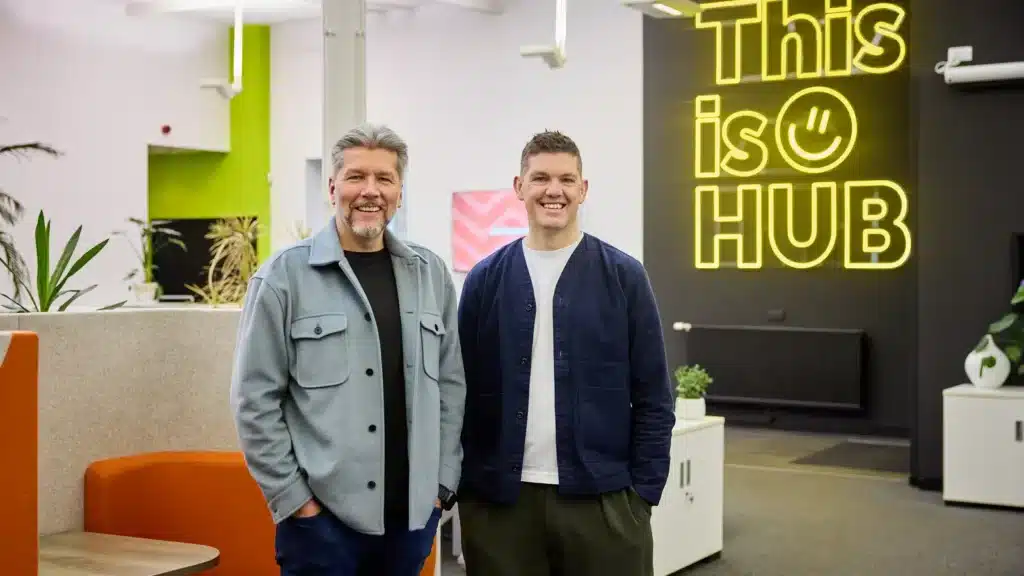
Responses came from leaders working across retailers, regulated organisations, private equity-backed firms and national businesses. Their circumstances varied but their answers repeatedly returned to the same six recurring concerns:
- Brand budgets remain under constant pressure as CMOs struggle to defend long-term investment against short-term commercial demands.
- Marketing continues to fight for boardroom legitimacy, with the function often treated as a cost rather than a driver of growth.
- Proving impact is a translation problem, with marketers expected to express results through the language and metrics finance already trusts.
- AI is creating pressure as well as opportunity, bringing hype, integration challenges and demands for rapid transformation.
- The CMO role continues to expand, stretching into commercial strategy, data, technology, product and ecommerce.
- Internal politics often block good marketing, long before an agency ever receives a brief.
For David, who joined Leeds-based independent agency HUB in February, the findings presented a challenge to agencies as well as marketing leaders, to look beyond campaign delivery and understand the commercial, organisational and personal pressures shaping the decisions clients make.
PROLIFIC NORTH: So, what was the question you asked your network?
DAVID SLATER: It was deliberately simple: “What are your top three challenges right now?”
I wanted it to be open enough that people could tell me what was genuinely occupying their time, rather than leading them towards the subjects I expected them to raise.
What came back was not a series of unrelated problems. It was the same handful of tensions described from different perspectives.
You had people in different sectors and at different stages of their careers, but they were often wrestling with remarkably similar issues.
PN: What prompted you to ask CMOs and senior marketers that question in the first place?
DS: A lot of it comes from my background. I don’t necessarily see myself as a service provider. I see myself as a problem solver and, hopefully, as a peer to many of the people I work with.
Before moving into agencies, I spent around 20 years in recruitment, often working with people at senior executive level. You were either helping a client solve a business problem or helping an individual progress in their career. Both required curiosity and an understanding of what made people tick.
That means I naturally approach conversations by asking: what are they trying to achieve, what is standing in their way and where might I be able to help?
Rather than inventing a topic I thought would resonate, I wanted to hear directly from marketing leaders about the problems they were facing. We could then explore whether there was an opportunity for me to help through my network or for HUB to support them as an agency.
PN: Before you asked them, what did you expect to hear – and what surprised you?
DS: I expected AI to feature, alongside the expanding remit of the CMO and the perennial debate between brand and performance.
What surprised me was the way AI was discussed primarily as a pressure rather than an opportunity.
There is an assumption, particularly among non-marketers, that AI means people can do their jobs better, faster and perhaps more cheaply.
The reality is that CMOs are already managing an enormous remit. They now also have to decide which tools genuinely help, which create risk and how to integrate them without disrupting the business.
Most of the people I spoke to were not resistant to AI. They wanted to embrace it. But the scale of the change-management challenge, and the pressure to appear ahead of the curve, came through much more strongly than I anticipated.
PN: One of the strongest themes was marketing still having to justify itself in the boardroom. Why do you think that is still happening?
DS: There is a perennial boardroom challenge for CMOs.
One respondent said their first challenge was simply “getting marketing at that table in the first place”. Another talked about a limited understanding of marketing’s strategic role, with the function reduced to communications rather than being allowed to lead on growth, proposition and innovation.
Marketing can still be viewed as a cost centre rather than a growth investment. It is seen as necessary, but also as something that can be cut when conditions become difficult.
Sales and commercial teams often have a stronger voice because they speak a language the board and finance already recognise. Marketing can involve longer-term outcomes and a more complex relationship between activity and results, which can be harder to articulate.
One respondent told me they rebuilt their marketing reporting because the previous numbers “never made sense” to the CFO.
That is revealing. CMOs do not necessarily lack data. The problem is that marketing data and the information the board actually uses can feel like two different languages.
Agencies can help by building measurement frameworks around business metrics and the numbers finance already trusts, rather than defaulting to marketing terminology that has to be re-explained every quarter.
PN: Brand-building came through repeatedly. Why are CMOs still fighting to defend long-term investment?
DS: It is not a new tension, but what stood out was how universally it was raised.
One respondent described the challenge as maintaining commitment to long-term brand-building while facing short-term profitability pressures. Another said that anything which could not be measured through last-click attribution became difficult to defend.
Brand and upper-funnel budgets are often the first place businesses look when they need savings, precisely because the return is harder to connect to an immediate sale.
I did not fully appreciate the interdependence of brand and performance until I worked at McCann, where there was a very clear way of talking about effectiveness. The two cannot sensibly be treated as separate conversations.
Interestingly, Google recently joined a call with one of our clients and recommended supplementing performance activity with greater brand investment through TV. Traditionally, the answer from that world might simply have been to spend more on paid performance.
The agency’s job is not to sell a brand campaign and then leave the CMO to defend it. We should help build the board-ready case for that investment and continue making it alongside the client.
We should also plan for potential cuts before they happen. When budgets tighten, the conversation should be about understood trade-offs and their likely consequences, not a last-minute scramble that damages long-term brand equity.
PN: AI came up in almost every conversation, but perhaps not in the way people might expect. What did you learn?
DS: It appeared as top-down pressure, hype that needed managing, an integration challenge and, in some cases, a threat to marketing’s credibility.
One respondent talked about constant pressure from the C-suite to remain at the forefront of AI and large language model visibility. Another described the challenge as cutting through the hype to build credible use cases, expectations and returns.
Someone else was frustrated by AI being treated as “the silver bullet for everything”, while another described the task as “leading AI transformation without creating chaos”.
That last point is important. The risk is not simply that a business falls behind. It is that it adopts tools badly, destabilises teams or introduces technology without understanding how it fits into existing systems and workflows.
Marketing leaders have always had to keep pace with new technologies and channels. AI is evolving faster than almost anything that came before it, and embedding it effectively can make the CMO feel like a part-time transformation director.
An agency should bring a clear, hype-free view of where AI genuinely helps and where it does not. It should help clients cover ground they may not have time to explore themselves, rather than adding another voice to the noise they are already managing.
PN: You argue that agencies need to stop thinking of themselves as suppliers and start acting more like partners. What does that look like in practice?
DS: Good agencies already do that, but the strongest relationships are usually strategy-led rather than channel-led.
In recruitment, we would remind ourselves that we were consultants, not simply a service provider. You were there to add value, and that sometimes meant being prepared to be the unpopular person in the room.
You might need to deliver bad news, challenge an assumption or recommend a different course of action. Provided the advice is evidence-based rather than emotional, it usually strengthens the relationship.
The same applies in an agency.
In a full-service agency with several capabilities, there can be many “front doors”. A relationship might begin through SEO, media, creative or another particular service. The danger is that the agency becomes permanently defined by that initial channel and never enters the wider strategic conversation.
A genuine partner talks about business objectives, not only marketing objectives. They understand how the work connects to growth, profitability, product, sales, data and the issues occupying the wider leadership team.
It also means accepting that an agency will often be one partner rather than the partner. We should not assume we are the answer to every problem. We need to understand where we can add the most value and work constructively alongside the client’s other partners.
PN: You also talk about agencies understanding the politics inside a client’s business, rather than only the brief they are given. Is that something agencies often overlook?
DS: Without a doubt.
An initial question might uncover 10% of the problem. You need secondary and tertiary questions to reach the root cause.
Agency sales has historically often been transactional and based around an immediate need. It is easy to become excited by the first answer and start producing a solution.
But unless you understand the internal politics, the implications of the work and the credibility of the person briefing you, you can get it badly wrong.
Who does the CMO report to? Who needs to approve the work? Which voices carry the most weight? What might cause a strong idea to be watered down or blocked?
Several respondents pointed to decisions by committee, excessive caution, operations getting in the way of brand and projects driven by internal sponsors rather than strategic priorities.
Those are not necessarily creative or marketing problems. They are organisational ones, and they are often invisible because they do not appear in the agency brief.
A good partner understands that environment and shapes recommendations so they are easier for the CMO to sell internally. They provide evidence that helps the client push back against “safe” ideas which may actually be less likely to work because they are not distinctive enough.
Sometimes the most valuable thing an agency can be is a candid external sounding board. That means behaving like a consultant rather than simply a service provider.
PN: Were there any answers that genuinely changed the way you think about working with clients?
DS: I would not say they fundamentally changed my approach, because many of the relationships in my network are already built on trust and on working in this way.
But the answers highlighted the opportunities agencies still have to improve.
It is not enough to deliver good work through a particular channel. You need mature, experienced people who can spend meaningful time with key stakeholders, understand the wider business and bring strategic thinking to the relationship.
That is often the role a really good strategist can fill.
It also reinforced that these relationships cannot be manufactured overnight. You cannot expedite trust.
Winning work from new brands is difficult because senior marketing leaders often have relationships with existing partners that have developed over many years. You have to invest the time, understand their world and demonstrate your value consistently.
PN: If you asked the same question again in two years, what do you think would have changed – and what do you suspect would not?
DS: I do not think there will be a quick fix to the tension between brand and performance.
I also suspect there will continue to be a boardroom challenge, with marketers having to establish their credibility and demonstrate the commercial importance of what they do.
Perhaps AI will help non-marketers become more marketing-aware. It might also help marketing leaders explain the importance of areas such as brand more effectively.
The danger is that AI also makes it possible for almost anyone to produce a marketing strategy that looks plausible on the surface. That could make it even easier for experienced marketers to be second-guessed by people who do not fully understand the discipline.
The shape of teams will also keep changing. The role is broadening, the tools are evolving and internal capability is rarely static.
What is right for a business today may not be right in six months, never mind two years.
PN: If you could give one piece of advice to agency leaders and CMOs navigating these challenges in 2026, what would it be?
DS: Invest in your peer-to-peer network before you need it.
I am part of several strong CMO networks. I am not a CMO, but I have lived and breathed many of those challenges, and I think people value the perspective I can bring.
Those groups create a safe environment in which people can ask what they might consider a stupid question, challenge their own thinking and receive an impartial view from someone facing a similar situation.
I still meet marketers who admit they are bad at networking and only begin doing it when they need something.
My advice would be to treat it as a discipline. Carve out the time, invest in relationships and start building the connection that could become incredibly valuable five years from now.
David joined HUB as Growth Director in February 2026, describing the move as a purposeful return to an independent, founder-led agency. He entered the agency sector around five years ago after a 20-year career in recruitment, which included launching his own business and holding senior roles with Michael Page in the UK and Canada. He later joined Leeds-based Search Laboratory, helping to develop its growth operation before and after its acquisition by Havas, and subsequently worked within Havas and McCann.
HUB is an independent integrated agency based in Leeds, with capabilities spanning strategy, creative, content production, digital, media and data. Slater’s role focuses on partnership-led growth and deepening the agency’s relationships with existing and prospective clients.