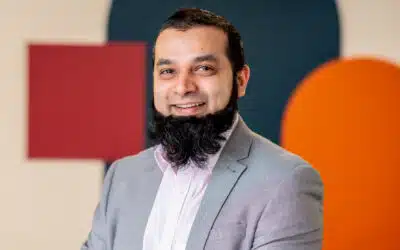


Hannah Evison-Frost is managing director at Trunk, a 60-strong Manchester-based integrated marketing agency working with brands all over the world, including GE Healthcare, Greene King Pubs, Jack Daniel’s, Gallagher, Moonpig, Paddy Power, Collection Cosmetics and TeamViewer.
Now a senior marketing leader, she built her career without a formal marketing qualification and over the past 15 years has worked her way up from junior account roles in PR to leading one of the North’s most ambitious agencies.
From how she first broke into the world of marketing to what has inspired her most, she shares her career journey along with some of the biggest lessons she’s learnt along the way…
How did you first get into your industry?
After dropping out of university at 19, I fell into sales and events and dipped my toe into marketing at Revolution Bars. I quickly got a taste for PR, comms and marketing and fell in love with the pace, the creativity, and the fact that no two days are ever the same.
I’d always been creative, entrepreneurial and a people person, so I knew that a service-based creative role was where my future lay. From there, I made the leap into a full-time PR role at the most junior level possible, determined to learn everything from the ground up.
What do you love about your job?
I am unhealthily obsessed with people, and I mean that in the best possible way. For me, marketing has always been about understanding people and their behaviours. That same obsession is what drew me towards leadership too; I love being able to help, support, nurture and grow the people around me. Getting to combine my passion for marketing with my passion for people feels, genuinely, like a dream.
Who – or what – has inspired you in your career?
Over the years I’ve been fortunate to have some brilliant line managers and role models, but if I’m honest, my biggest inspiration has come from the leaders I didn’t rate quite as much. Without naming names, I had an experience in my early twenties where I was managed so poorly that it has stayed with me ever since. From that point on, I knew exactly the kind of leader I wanted to be and it was the polar opposite of what I’d experienced.
What are the biggest challenges about your job?
The marketing industry right now, and the agency model in particular, is under enormous pressure. We’re being asked to do more, faster, cheaper and to a higher standard than ever before, all while managing an ever-increasing cost base. That tension is real and it’s something the whole industry is grappling with.
What skills have been the most crucial to you succeeding in your career so far?
I’ve been told on more than one occasion that my resilience levels are superhuman, and in some ways, I think that’s true. I’m extremely pragmatic in a professional context, even if that’s less the case at home, and I think being able to separate those two versions of myself genuinely keeps me sane.
I’m also unapologetically ambitious. I don’t really see blockers; I see routes around them. I use the phrase “closed mouths don’t get fed”, and I truly believe it. You have to be explicit with the people who can help you about exactly what you want, because nobody is going to be ambitious on your behalf. You have to own your own destiny, and my approach to life has always been proactive rather than reactive.
Beyond that, I hope I’ve grown into an empathetic leader who lives by the ‘Radical Candor’ theory. Another good audio book for aspiring leaders or managers in any business!
I’m also not afraid to get my hands dirty. I don’t see myself as more important than anyone else in my business and I would never ask anyone to do something I wouldn’t do myself. That’s just not who I am and it’s not the kind of culture I want to be part of, at any level.
What was your first salary and what could someone getting into the industry expect to earn nowadays?
My first full-time salary was £12,300 a year, and honestly, I thought I was loaded. The salary was so low I barely paid tax on most of it, but coming from earning £2.35 an hour for a few hours a week in a hotel, it felt enormous. The industry has come a long way since then, and at Trunk we’re committed to making sure even our most junior employees are paid at least the National Living Wage (£26,436 p/a), because nobody should have to start their career feeling like they can’t afford to be in it.
What education or training would be most useful for someone looking to follow your career path?
I know this can be a divisive opinion, but I genuinely don’t believe you need formal education to have a successful career in marketing. For those who know they thrive in a classroom environment, the academic route is a solid way to grasp the fundamentals but that was never me, and I know I’m not alone in that.
I learn best by doing; by being in the thick of it and getting my hands dirty. It’s part of the reason we regularly hire apprentices and juniors with no formal qualifications at Trunk – some of these people have the most incredible attitudes to learning I’ve ever encountered, and in 2026, that mindset can be worth more than any degree.
There are plenty of courses I’d recommend for upskilling in specific channels, and I do encourage people earlier in their careers to explore these to find their niche and work out what genuinely excites them.
But if you’re a more practical learner like me, podcasts and audiobooks around marketing strategy, consumer behaviour, building and growing brands, measurement and effectiveness, as well as AI and the future of marketing, are where I’d point you. I’d add in leadership, too, if that’s where you see your career heading. I love podcasts, possibly too much; I’ve given myself knowledge-paralysis on more than one occasion, so you do have to be careful.
What advice would you have for someone looking to follow your path?
In the early days of my career, I said yes to everything – not in a self-destructive way, though I’ll admit I probably worked far too many hours – but I said yes to every opportunity to meet someone new, work on a new pitch, take on a new client, or try something different. That open-minded, growth-focused approach helped me learn quickly, and it meant I worked out fairly early on what I was truly passionate about, and what I wasn’t. If I could bottle one piece of advice, it would be that.