


A year after launching its UK operation, adtech pioneer Buymedia has more than doubled revenue, grown the UK’s contribution sixfold and put down roots in Manchester. Founder Fergal O’Connor tells Prolific North why agencies should look beyond the latest AI panic and embrace the opportunity to become more creative, strategic and valuable.
A year ago almost to the date Buymedia arrived in Manchester with an ambitious promise to “democratise advertising” – and the backing of the city’s then mayor, Andy Burnham.
Twelve months later, Burnham is in Downing Street, Buymedia’s founder has moved to Manchester and the Irish adtech company says its UK business has grown from 5% to around 20% of total revenue. The company has also opened a Belfast operation, supported by First Minister of Northern Ireland Michelle O’Neill, and has entered several European markets, revenue growth of 136% year on year.
But Buymedia’s first Manchester anniversary arrives at an awkward moment for the industry after some of the most powerful figures in technology have spent the past few weeks arguing over whether the development of advanced AI should be slowed. Anthropic’s Dario Amodei has called for greater coordination and external safety evaluation, with figures including Sam Altman, Elon Musk and Demis Hassabis supporting stronger safeguards. Meta’s Mark Zuckerberg and Nvidia’s Jensen Huang have resisted a coordinated slowdown. The dispute has divided the industry and prompted European AI companies to warn that a pause could simply entrench the dominance of the biggest US players.
But Buymedia founder and CEO Fergal O’Connor isn’t really interested in being dragged too deeply into a debate in which, he argues, the motives and politics are difficult to disentangle. He also believes it risks obscuring the really important decisions confronting businesses now.
“One day everybody’s bullish, and the next day everyone’s bearish,” he said. “It seems to be the same with AI. It’s either one extreme or the other. It’s going to save the world or kill the world.
“For us, it’s neither of those things – it’s just about using the technology for the purposes that are good for the business that you’re in.”
From machine learning to the AI gold rush
Founded in Galway in 2015, Buymedia has spent 11 years developing technology to help brands and agencies plan, buy, manage and measure advertising across different channels.
That long history matters to Fergal because much of what is now swept into the AI conversation predates the arrival of ChatGPT and the explosion of generative tools. Buymedia began by using machine learning to match customer profiles with the media those audiences were most likely to consume.
“A lot of people just blanket everything with the term AI without fully understanding what it means,” he said. “The thing that’s scaring people is more about the generative AI stuff – the creation of the ads and the writing of the content. It’s those pieces that people seem to be more fearful of.
“They were never fearful of the machine-learning bit because they could see: ‘Okay, I don’t have to now look at a spreadsheet and try and figure out that spreadsheet. The machine learning could do it for me.’ Now they’re worried: ‘Is my creativity going to be taken away by a machine?’”

The founder regards that 11-year head start as a valuable advantage, but not one that allows the company to stand still. During the past 12 months alone, he said, Buymedia changed the models underpinning one development project five times as the technology improved.
“There’s been a huge amount of work and effort gone into understanding not just what the right models and the right tools are, and where to use the automation and where to use AI and where to use machine learning, but also the processes,” he said.
“People will go: ‘Sure, I could spin something up in Claude over the weekend that could do all of this.’ But it’s actually the hard yards, the blood, sweat and tears that have gone into the last 11 years of understanding the whole landscape of the processes, and then understanding what the right technology is to use in those processes. That I think is hard to replicate.”
The end of selling hours?
For agencies, Fergal believes the immediate disruption is less dramatic than machine overlords – but considerably more relevant to their survival.
Much of the industry has traditionally charged clients for the time taken to develop plans, produce creative work, buy media and compile reports. AI can now complete some of those tasks almost instantaneously, leaving clients entitled to ask what exactly they are paying for.
“The traditional agency model was hourly billing,” he said. “Now what’s happened is that billable hour can be done in a split second by AI.
“The agencies, I think, have to reimagine the way they’re pricing their business and the way they’re presenting themselves to their clients.”
The answer, he argues, is to sell the value of human experience, judgement and strategy rather than the number of hours required to execute a task.
“What you’re paying for is not our hour that it took us to do this thing. It’s actually paying for our 15, 20 years of understanding and strategy, and what works best for your industry in different media and different markets for different customers,” Fergal said. “You’re selling value rather than selling hours.”
His prediction is that AI platforms will eventually become as unremarkable and essential to agencies as computers. The software will create audience profiles, prepare plans, support buying and execution, compile reporting and feed the results back into the next campaign. If every agency has access to broadly similar capabilities, the decisive question becomes what its people add.
Some agencies have responded to the generative AI boom by positioning themselves as human-only or human-centric. He accepts that there may be a market for that approach, but doubts it can become the industry norm.
“We’re in this transition period where there are a lot of both clients and agencies looking at: ‘Do we embrace AI or do we stay away from it?’” he said. “It will become like a computer or an operating system that every agency will just have.”
AI agents move into media buying
Buymedia is now preparing to take that automation a significant step further. Fergal said the company has already spent several years in research and development and expects to launch agentic AI media planners and buyers within the next few months.
Its platform already uses AI to build a media plan from an audience profile. Until now, programmatic systems and human buyers have then worked with media owners to gather proposals, negotiate and execute that plan. Fergal said AI agents will increasingly perform that work.
“The AI agents are now doing the negotiation with all the media companies and getting the proposals back and doing all the buying automatically,” he said.
“You’re going to have agents in the middle of this doing a lot of what was formerly a human task. It’s not that that should impact the roles within agencies, but it’ll impact the way people work within the agencies.”
His optimistic case is that agencies can move those employees into more valuable strategic roles. The technology, he argues, should remove the reporting, spreadsheet work and repetitive administration that consume the time of people who entered the industry to think and create.
“People go into creative agencies to be creative,” he said. “What they end up doing is spending 70% of their time aggregating and consolidating reports for clients.
“What we’re trying to do is take all those tasks and all those pieces of dreary drudgery work away from the people who want to be creative, to free them to have time to be more creative thinkers and be more strategic about how they can help clients.”
That argument is being tested across an advertising sector already shedding jobs. The Financial Times reported this month that WPP was preparing to cut up to another 1,000 roles, following much deeper reductions across the major agency groups as clients cut costs and AI reshapes how work is delivered.
Fergal does not dismiss the employment risk. In fact, he believes one of the most serious problems is what happens to the people who have traditionally learned their skills and knowledge of the industry by starting as a junior executive and working their way up through the ranks.
“The real challenge for us as a society is what’s going to happen to the younger people in industry coming through, who would have normally been the ones who learned their craft through interaction with more experienced colleagues who learned through osmosis of being in an office, surrounded by talented people,” he said.
“What happens then if they were outsourcing those tasks to a junior person within the business? How are they going to learn their craft? I think there is a bigger piece there. It’s industry that should be worried about where the talent is going to come from.”
New roles will emerge, he believes, including people responsible for managing and scrutinising teams of AI agents. Yet that does not resolve the immediate question of how agencies develop the next generation of strategists when many of the tasks through which they once learned are automated away.
A human still in the loop
Despite building a business around AI, Fergal rejects the idea that the technology can yet operate without human scrutiny.
“You still need the human in the loop with a lot of these machine-learning and generative AI models to actually sense-check what’s going on,” he said.
He also warns businesses against allowing employees to pour commercially sensitive information into public and open generative AI tools. Companies may have policies at board level, he said, but data can still escape when an employee faced with an urgent task uploads customer, sales or financial information to an open model.
“The really key thing in terms of the implementation is it has to be closed,” he said. “If you’re an agency or a business that’s bringing in some form of AI, it has to be a closed loop.”
Buymedia’s pitch to agencies is that they can gain access to specialist AI and data capabilities without attempting to recruit their own teams of computer scientists and developers. O’Connor said the relationship has shifted from early suspicion that the platform might compete with agencies towards greater interest in collaboration, driven in part by clients demanding to know how their agencies use AI.
Manchester, Burnham and the Northern opportunity
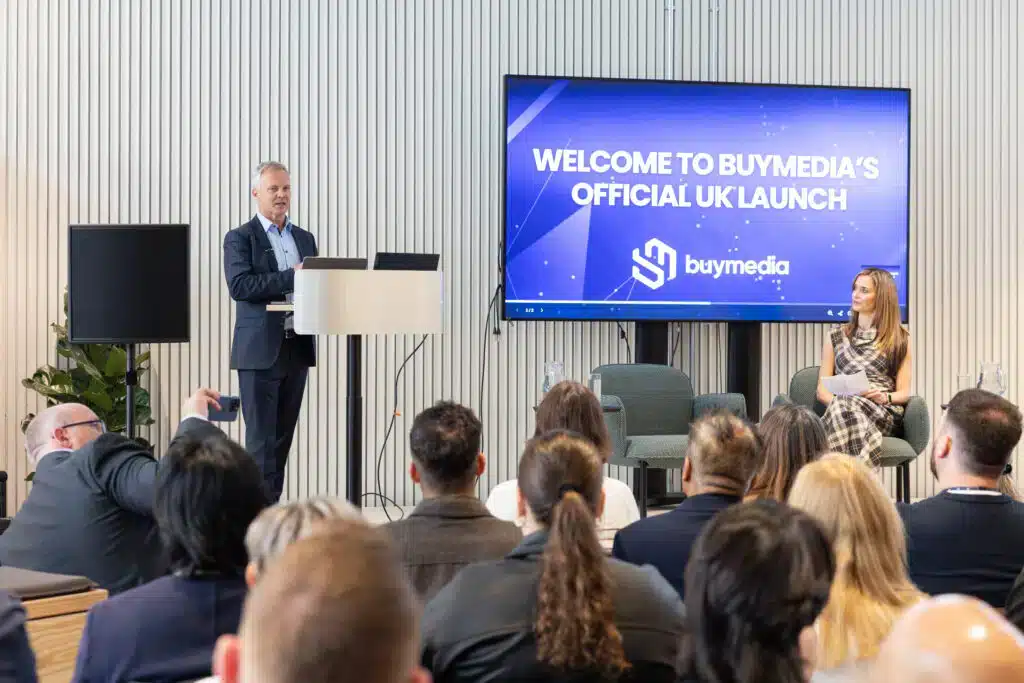
When Buymedia formally launched its UK operation in Manchester on October 3, 2025, it had considered London, Edinburgh and Cardiff.
Manchester won because its universities, businesses, public bodies and media organisations behaved like parts of a connected ecosystem, Fergal said. “It’s the people here that have made it. If they can’t help you themselves, they’ll introduce you to somebody that can,” he said. “It’s been really brilliant for us being here.”
The decision has acquired wider significance following Burnham’s move from Greater Manchester mayor to Downing Street. Buymedia featured recently in an Economist examination of whether the collaborative “Manchester model” can become a template for national technology policy.
Fergal first met Burnham at the inaugural UK-Ireland Summit in Liverpool. He said the relationship with government remains strong, with Buymedia even invited to offer advice on AI legislation.
“Following the UK-Ireland Summit we were invited to contribute to the UK-Ireland Strategic policy document to help develop opportunities to boost jobs, growth and trade and collaborate across innovations of the future.” he said.
Speaking about Buymedia’s UK launch then-Mayor of Greater Manchester Andy Burnham said: “Buymedia is already a standout success in Ireland’s tech sector, and we’re proud they’ve chosen Manchester as their UK launchpad. This is a major step in their international journey and a vote of confidence in our region’s innovation and technology ecosystem.
“It’s important that businesses not only in the region but across the UK embrace new technological and innovative tools and platforms like Buymedia to help them to grow and scale their businesses nationally and internationally.”
Manchester is only one part of Buymedia’s expansion. The company opened a base at Ormeau Labs in Belfast in May as part of its £1.5m investment plan and proposal to add 30 roles across Ireland and the UK.
The UK now accounts for around 20% of Buymedia’s revenue, up from approximately 5% a year ago, Fergal said. One UK customer has also taken the platform into Germany, Belgium, the Netherlands and Luxembourg.
The US market remains the other potential prize, but Fergal is resisting the temptation to rush. He expects Buymedia to spend another four or five years developing its Irish and UK operations before attempting that move.
For now, the largest obstacle is neither the technology nor the latest warnings from Silicon Valley. It is inertia, he says.
“People see the platform, whether it’s an agency or client, and they go: ‘Oh my God, this is amazing. This is the future. This is the way things should be going.’ And then the inertia is: ‘But I’ve been doing this this way for the last 10 years.’”
Every disruptive technology, he argues, eventually reaches a tipping point when caution gives way to widespread adoption. After spending 11 years building through the period when few people cared about AI, Fergal believes Buymedia may finally be approaching its own.
“People were possibly, maybe 12 or 18 months ago, still in the phase of: ‘What do we do about all this AI stuff?’” he said. “Now they’re at the phase of: ‘We need to do something about AI , and we need to figure out how we’re going to do it.’
“Hopefully our timing is right.”
It would certainly seem so!