

When Liam Gallagher stepped out in the Berghaus Trango Icons jacket, it wasn’t a marketing gimmick. It was a genuine love affair that started in the 1990s and came full circle in 2024 with one of the year’s most talked-about brand collaborations.
At Prolific North Live 2025, Emily Lewis, Senior Comms Planning Manager at Pentland Brands, and Jenny O’Sullivan, Digital Client Partner at EssenceMediacom, lifted the lid on how a simple truth — “Liam genuinely loves the jacket” — became the foundation of a campaign that reignited Britain’s love for Berghaus and turned a nostalgic fashion staple into a pop-cultural power move at the heart of one of the biggest comebacks in a generation.

“We wanted to reignite Britain’s love for Berghaus,” Lewis explained on the Trendsetters stage at UA92 in Manchester on 6 November. Competitors had begun muscling in on the outdoor fashion space and the goal was to remind consumers that Berghaus wasn’t just a functional gear brand – it is a British outdoor fashion powerhouse with serious street cred.
The Icons campaign set out to “redefine Berghaus using nostalgia, but through a fresh, modern aesthetic.” The team knew the look and spirit of 1990s Britpop carried cultural weight — but it had to feel earned, not borrowed. And one man in particular was perfect for the job.
“Liam really is a true British icon,” said Lewis. “He sparks conversation — sometimes for good, sometimes slightly more controversially — but ultimately he creates a buzz we wanted to harness.”


Unlike many celebrity tie-ins, this one started from authenticity. Gallagher had worn the jacket on stage in 1997 during the “Here and Now” tour, propelling the brand into the 90’s music space. “That authenticity is what made the whole thing work,” Lewis said.
The campaign was shot by British photographer Alasdair McLellan, whose portfolio includes every major British cultural figure — “every icon bar Liam before now,” as Lewis put it – giving the work both credibility and visual clout.
“We didn’t want to just flog a jacket,” she added. “It was about making a statement, bridging generations with a British icon.”
A once-in-a-generation cultural moment
Then came the lightning strike. The Oasis reunion tour announcement dropped just weeks before launch. Some might say they got lucky, but it was a once-in-a-lifetime opportunity, 20 years in the making, that they weren’t going to miss.
With 1.4 million tickets sold and 14 million fans trying to get them — “that’s ten fans for every ticket,” she said — the campaign rode a wave of nostalgia few could have predicted
But as O’Sullivan noted, they weren’t the official tour sponsor. “That was a certain brand with three stripes and a much bigger budget,” she said. “We had to think practically – challenger brand mentality all the way.”

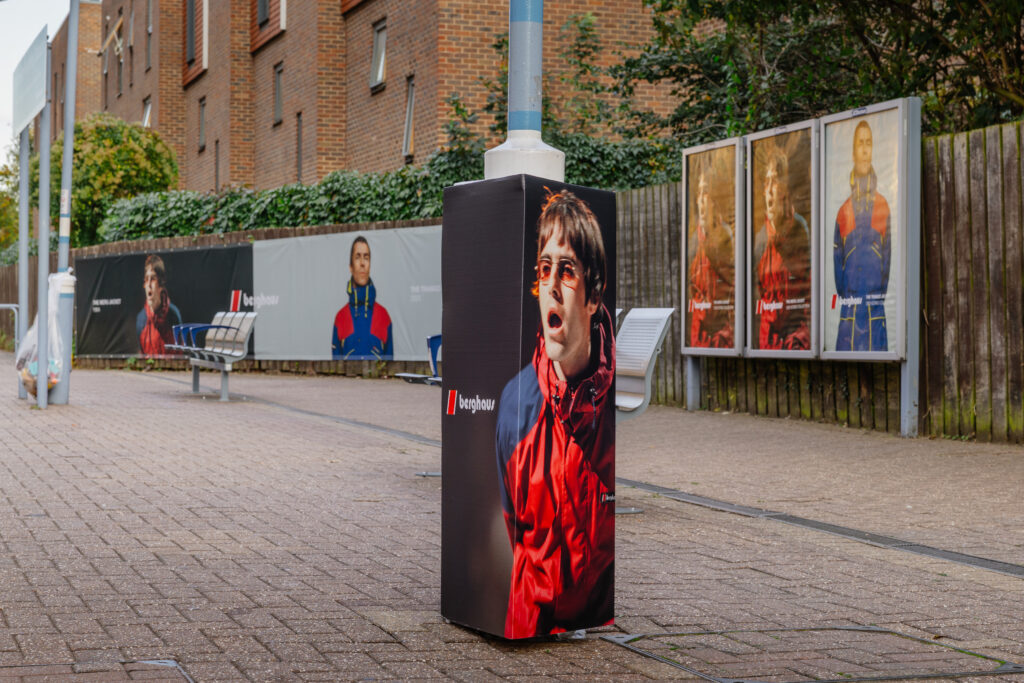
With stunning campaign imagery, out-of-home became a core pillar of the campaign. Two hand-painted murals towered above Shoreditch and the Northern Quarter in Manchester, while roadsides, Underground sites and digital screens extended the reach.
“These murals became part of the fabric of the cities,” said Lewis. “They lived in the same spaces as our target audience — young, style-conscious consumers, bars, vintage shops, music venues.”
Social media then amplified the buzz. Photos of the murals flooded timelines as fans flocked to the campaign as tour fever ramped up.
And Berghaus didn’t stop there. When Oasis hit the road, the brand hijacked the hype wherever they could. They even got a tram wrapped with Liam on it in Manchester during the Oasis Heaton Park homecoming gigs and city-centre takeovers in London and Manchester followed. So popular were the activations that it even had fans stealing lamppost ads as souvenirs. “That was a first for me,” laughed Lewis.
The ripple effect went far beyond the UK. Gallagher himself posted photos from Times Square, where Berghaus secured screen space during Oasis’s US leg. Even Drake (accidentally) shared the campaign. The pieces quickly became the must-have merch of the summer, spotted on stars like Annie Mac.
Results: From hype to hard numbers
The Trango jacket sold out in 72 hours, becoming one of the fastest-selling pieces in Berghaus history. Ad awareness jumped nearly 300%. Social mentions skyrocketed, with coverage in outlets the brand had “never been mentioned in the same breath as before.”
Retail partnerships with Selfridges and other premium stores helped reinforce Berghaus’s repositioning from outdoor gear to fashion statement.
Asked to distil the campaign’s success, Lewis and O’Sullivan were clear:
- Authenticity first. “Liam’s genuine affinity for the brand made everything else credible.”
- Collaboration across teams. Internal teams and partners worked hand-in-hand to maximise the moment.
- Big-brand behaviour on a challenger budget. “We didn’t have deep pockets,” said Lewis, “but we packed a punch way beyond our spend.”
The Berghaus x Liam Gallagher story wasn’t about nostalgia for its own sake. It showed how cultural moments can become competitive advantage — when they’re real, relevant and rooted in place.
Over the coming days, we’ll be sharing in-depth coverage from all the sessions at Prolific North Live, which was headline sponsored by Dotdigital, Slater Heelis, Buymedia and CTI Digital.