

There are currently more than 250 businesses working at MediaCityUK
A city of the future
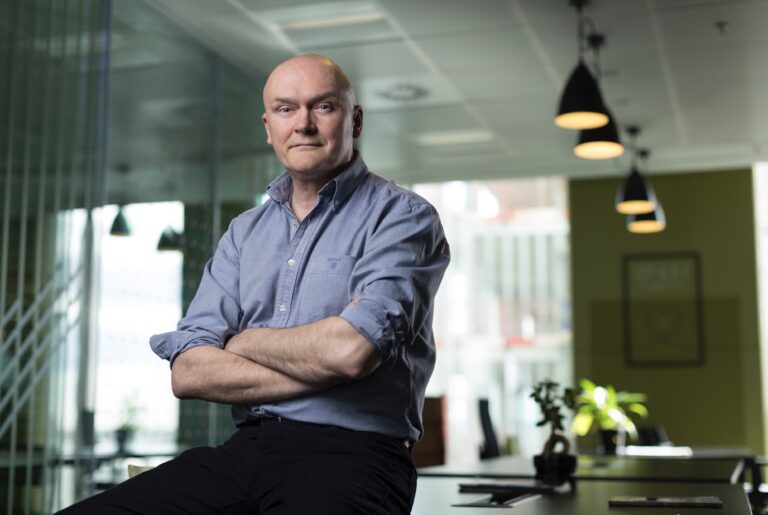
His role as part of Digital Salford and the City of Salford bodies means that he determines strategy, priorities, themes and investment areas that will make a difference to Salford’s economy and its collaborative digital role in Greater Manchester.
He said: “I think MediaCityUK will evolve into an exemplar smart city where city leaders can come and actually see tech being demonstrated, a place where large companies can work with small companies on deployments. With networks of connected devices, connected environments, it really is a place where we can physically test new technologies.
“Before we start deploying new products in our other urban spaces, we have MediaCityUK where we can do this in a frictionless way by making use of the tech here. We can really drill into the mechanisms of this connected city and the data platforms needed and the regulation that’s required. All of that can be tested, deployed and proven or not.”
Salford is racing to become one of the world’s most attractive cities for digital enterprise. In 2017 it surpassed London to become the UK’s leading city for percentage increase in startup growth and is expected to have the fastest job increase rate in Greater Manchester.
The technological infrastructure in MediaCityUK itself is “second to none,” Jon says. It has had 5G for nearly a year, a network which he believes will impact every industry, change the way supply chains work, and be a carrier of new digital products. At The Landing, Jon’s focus is on empowering microbusinesses, SMEs and young entrepreneurs by wrapping IT services around them to help them innovate within a testbed environment, and work collaboratively with others.

The Landing’s tech functionalities help make it a successful business accelerator
The “eclectic” mix of companies at The Landing, which apparently has a long waiting list, includes ethical hackers, cybersecurity startups, a digital publishing company, UX companies, VR testers and others. Jon describes it as a ‘plug-and-play’ environment and with over 45,000 sq ft of space; The Landing tends to take on between 90 and 120 businesses at any one time.
Not a smart city, the smart city
Digital Salford, the coordinating body leading on the city’s strategy to establish itself as a leading digital economy, puts the citizens at the core of its aims. Jon said: “The central vision is about making Salford the most connected city for its people, and how we link that together with MediaCityUK an exemplar space for smart and connected technologies.”
He says the traditional definition of a smart city tends to be a ‘command and control’ centre, which records metrics like air quality data, traffic light congestion and energy usage. “They’re all good things. But they’re all about technology and controlling your physical assets. Yes, I want to do that in Salford but I also want to start with people. What particular things do we need from a city to help people improve their lives?
“When you do take that approach, you start looking to improve other areas such as health and social care and connecting schools and young people, especially disadvantaged groups,” Jon said.
Development agenda
The city’s digital strategy acknowledges the need to create local talent and has identified 8,000 of the area’s most vulnerable residents for programmes that will equip them with valuable digital skills, either through education or retraining them.
“
The digital world is going to grow. It’s going to become more connected and that will have fantastic benefits. It will also have enormous societal challenges.
1
“We need to look at how we get upstream and get people involved in the opportunities as early as possible. I think all of our communities can take advantage of that.”
The 20 or so programmes that Digital Salford is rolling out this year aim to identify people in companies and help them start to reskill, upskill and retrain in order to take advantage of new technologies.
According to Jon, the question isn’t about whether digital is important to people, it’s that people are important to digital. He adds: “It’s a question of what we are doing as citizens and communities, how we can understand what the opportunities are and most importantly, how to create our own solutions, policies and approaches.
“We can’t continually look at a digital world through an analogue lens. We have to start thinking differently and doing things differently.”
Digital City Festival sponsors