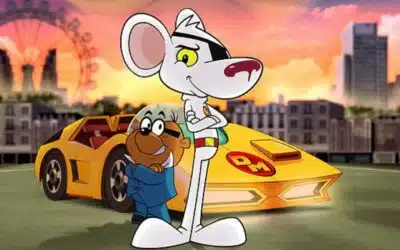


From children’s classics like Danger Mouse to the moving short film Two Black Boys in Paradise, and Krygon Studios’ double Emmy-winning animated visuals for UFC in the Vegas Sphere, Greater Manchester has long been a powerhouse in the UK animation sector.
Now, it’s poised to shape the next era of growth. That momentum comes courtesy of the government’s £150m Creative Places Growth Fund, with Greater Manchester named as one of six regions to receive £25m to help create new jobs, boost skills and attract investment.
For the region’s animation sector, the timing couldn’t be better.
Greater Manchester’s newly unveiled Creative Industries Sector Development Plan singles out animation as a key creative subsector, highlighting growth opportunities through ‘creative assets’ such as Mackinnon & Saunders.
Tucked away in a tranquil corner of Altrincham, Mackinnon & Saunders is one of the region’s most renowned animation studios, having brought Pinocchio to life through intricate puppet-making (which we were lucky enough to see in person two years ago) and contributed to the gothic and whimsical worlds of stop-motion blockbusters like Corpse Bride and Frankenweenie, to name a few.

But that’s only a slice of the region’s rich animation heritage. For decades, Manchester has been the birthplace of some of Britain’s most beloved animated productions, thanks largely to Cosgrove Hall. Founded in 1976 and operating until 2009, the studio produced iconic titles including The Wind in the Willows, Count Duckula, The BFG, and Danger Mouse.
Its impact didn’t end with the shows themselves. Cosgrove Hall became a launchpad for a new wave of animators who went on to form studios such as Mackinnon & Saunders, Factory (behind the Clangers revival), Hot Animation, and Kilogramme.
Industry veteran Jonathan Kershaw, now Programme Manager and Animation Specialist at the MediaCity Immersive Technologies Innovation Hub (MITIH), is well placed to reflect on the importance of that heritage as new immersive technologies emerge.
“What Manchester has, which perhaps other cities in the UK won’t have, is that heritage. To look forward, you have to bear in mind what’s in the past and as a consequence of that heritage, we’ve got a fantastic pool of creatives and freelance individuals in Manchester,” Kershaw tells Prolific North.
“We have Mackinnon & Saunders — they’ve got irons in the fire and they’re not afraid of innovating. Smaller studios are popping up from different people trying to find their own way in this new world. One6th Animation Studio’s hit Two Black Boys in Paradise was made in Manchester and it’s winning every award.
“We’re always on the precipice of something, and Manchester is very well positioned to lead that exciting new story in the world of animation. There’s a reason why it all happens in Manchester!”
But Kershaw is perhaps a little modest about his own career and the role he’s also played in shaping many of those waves of transformation in the region’s animation industry. We eventually settled on his “two decades” in the business, though it’s likely been much longer.
“I made the DJ decks for Pilchard the cat…”
While studying at art school in Bournemouth, he made his first trip to Altrincham for a work placement at Hot Animation. The team was working on later episodes of Brambly Hedge while riding the growing wave of what would soon become a cultural phenomenon: Bob the Builder.
“As a child watching Wallace and Gromit, I’d attempt to make little versions of them; it had always been an interest. So, to go and work for an animation studio? It was a bit of a treat!”
He came full circle in late 2000, going freelance and soon joining Hot Animation, where he worked on Bob the Builder just as the show’s theme tune “Can We Fix It” became a Christmas sensation, even beating Kylie Minogue, Eminem, and Westlife to the coveted number one spot.
“I made the DJ decks for Pilchard the cat,” he beams.
Beyond working on numerous Bob the Builder series and specials as the “craze” continued, he also worked on Rubbadubbers and watched as the revived Pingu series came to life. But when Hit Entertainment, owners of Hot Animation, was acquired by Mattel, “it all fizzled out.”
“We were all made redundant. Luckily for me, it was an opportunity to try some different things out,” he explains.
It also allowed him to return to freelancing, exploring TV and theatre work while collaborating with other regional studios, including Chapman Entertainment, founded by Bob the Builder creator Keith Chapman, which became renowned for stop-motion classics like Fifi and the Flowertots.
It later led to a larger project, Peter Kay’s All Star Animated Band, where he formed an important connection with Phil Chalk, a producer on the project. It was undoubtedly a feast for the eyes for animation fans, assembling over 50 iconic animated characters from the likes of Thunderbirds and Postman Pat to raise money for Children in Need.
“It was a short segment, but they needed to make so much stuff for the puppets. I went in and made all the electric guitars for the characters. It was a belting model job!”
After that project wrapped, their paths crossed again when Chalk launched animation studio Factory and needed props for Strange Hill High. Their collaboration continued with the satirical puppet series Newzoids, where they used 3D printing to create the show’s distinctive puppets.
Kershaw eventually joined Chalk at Factory full-time, establishing a dedicated prop, puppet and set-making facility and remained there until March 2024, when the studio sadly closed its doors for good following liquidation.
READ MORE: Voluntary liquidation at Newzoids and Clangers animation studio
“It really does feel like there’ve been some major highs. You have amazing institutions in Manchester from Cosgrove Hall, Mackinnon & Saunders, to Factory and the Bob the Builder days. The working environment was quite laid back. You never know when you’re in the good old days!”
Yet those highs have always come alongside the lows and pressures faced by many animation companies, but Kershaw seems to have a knack for turning challenges, like studio closures, into new opportunities in the creative industry.
“I can only speak for myself, but Factory had an agile setup, so when productions came in, you would crew up with freelancers to do the body of the work. We were the core team. I set up and built the prop facility, which needed to be maintained between projects. It wasn’t a big team that left at the end. For me, I took it as an opportunity to diversify again, the same as I did after Hot Animation, to try different things out. I ended up going up to the North East to work on the last series of Vera!”
“It’s always been an industry at the forefront of innovation…”
Now, he’s turning his hand to something equally important in his role at MITIH, which aims to advance immersive technologies across the region’s creative sectors and supports businesses to develop, test, and scale digital innovations.
It is also the base for the region’s Animation Task Force, which Kershaw chairs, bringing together freelancers, studios, industry leaders, and academics to identify skills gaps, infrastructure needs, and new opportunities.
MITIH has also supported a landmark sector survey to create a portrait of Greater Manchester’s animation, VFX, motion graphics, games cinematic, and immersive media sectors, tackling some of the challenges creatives face and improving the use of immersive technologies.
Reflecting on the industry’s evolution, he recalls how Hot Animation once used Super 16mm film with a VHS preview and cassette recorder to sync dialogue, whereas today digital cameras feed directly into computers with audio integrated, letting animators see their work in real time.
“It’s always been an industry at the forefront of what you’d call innovation, simplifying processes and finding better ways to do things has always been an important thing.”
That leads us, of course, to talking about the impact of AI on animation. As generative AI sweeps the creative industries, Dr Steve Henderson, co-founder of Manchester Animation Festival, recently warned it risks leaving animation “soulless.”
But Kershaw takes a more neutral stance: “It’s a tool in the box. Animation is, has and always will be an industry based on skills and talented people coming together to create and tell stories.”
He also reflects on other technological changes, such as replacing labour-intensive sculpting, molding, and casting of puppet mouths, for digitally sculpted and 3D-printed alternatives.
“You’re not stealing a high-skilled job from somebody, you’re just finding different, better ways of doing things, because the cost and the time to do that molding and casting process is pretty high, and they’re all hazardous materials. You’re alleviating a risk by removing that process, as well as saving a bit of time.”
That, he argues, is what ‘innovation’ really is: identifying a process that is time-consuming or hazardous and finding ways to improve it so someone’s skills are better spent elsewhere.
“AI is considered an immersive technology and we’re an immersive technology innovation hub. So it’s always on our minds.”
Kershaw’s optimism for the region’s animation future is fuelled by initiatives like the annual Animating Tomorrow event, held in partnership with Manchester Animation Festival, which explores the future of animation through AI, immersive technologies such as virtual and augmented reality.
“There’s a very concerted effort to look at what the future of innovation looks like in the animation industry. Through roundtables we’ve been holding, we’ve been talking about the challenges that we face and the innovative solutions to those challenges. There’s a big industry here, and it’s been interesting to witness the innovation for at least 20 years with my own eyes!”