


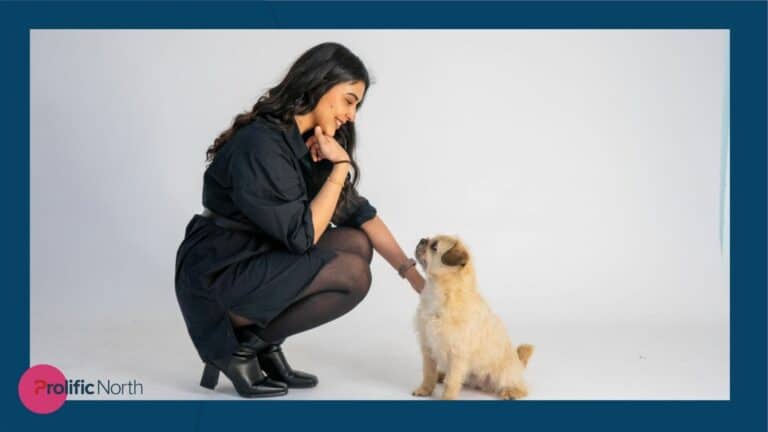

When Hanna Latif-Walmsley returned home from a gig to find water dripping into an electrical socket in her Manchester flat, her first thought wasn’t about the damage.
It was about her rescue dog Winnie’s safety.
If an electrical fire had started while she was out, how would anyone know her dog Winnie was trapped inside?
That fear would eventually inspire her to launch Laika Family, a Manchester-based pet tech start-up developing technology to alert emergency services or anyone nearby to pets trapped inside homes during emergencies.
READ MORE: ‘We’re making a bet on the North East’: Why confidence is growing across the region’s tech sector
Now, the early-stage tech firm is building a pet safety platform that starts with an app and will eventually connect to emergency response technology.
“I wouldn’t have started this business if I didn’t have Winnie, she’s had such an impact since we rescued her eight years ago,” Hanna Latif-Walmsley, founder of Laika Family, tells Prolific North.
“I never thought I’d be in the business of starting my own business.”
Latif-Walmsley had spent much of her career working in either the third sector or local government, trying to “make a difference” in any way she could. But she could never have imagined that she’d eventually be trying to make a difference as a tech founder.
After rescuing Winnie from an RSPCA branch eight years ago, fears over her pooch’s safety only began to surface after she moved into the fourth floor of a new flat in February 2024.
Beyond the leak, she recalls a conversation with a neighbour who revealed he had accidentally fallen asleep after putting food in the oven, further sparking her concerns.
“Who would have known what would have happened to the building if he didn’t wake up? Winnie’s safety now wasn’t just with me, it’s with everyone else in this vicinity. And if the building was on fire, who would know she was there if I was out? ” she asks.
“We’re on the fourth floor, so it’s not that easy to see a dog.”
She knew she had to do something to alleviate her own fears, so she started training Winnie to bark whenever the building’s weekly fire alarm test sounded to alert anyone nearby in the event of a fire.
“But then I realised that in a high state of emotion, people are not really listening out for dogs. And what about all the other animals that don’t have that voice – cats, rabbits, birds, and others?”
She highlights how “thousands of pets a year” are caught in house fires, with content creator and I’m a Celebrity winner Angry Ginge recently revealing the sad news that three family pets died in a house fire at his mum’s home in Salford.
“These stories are happening everywhere, there’s not a week that goes by without a story like that in the paper somewhere.”

‘There is nothing for fire emergencies when it comes to pets’
When searching for a proper solution beyond training Winnie to bark on command for fire alarms, Latif-Walmsley discovered there was little beyond home CCTV and window stickers warning emergency services that pets lived inside a property.
And after having conversations with fire and rescue service teams, it revealed another challenge.
If crews are aware that there is a pet in a property, they’ll “try to save them”. But if they aren’t aware of any pets in the property, rescuing those much loved pets inevitably becomes far more difficult.
So she set about creating a solution to the problem that had kept her awake at night.
The first version of Laika Family will launch as an app, giving owners a single place to store everything about their pets. It includes detailed pet profiles containing medical information, behavioural notes and even favourite hiding spots, all information that could prove vital in an emergency.
Beyond emergencies, the app also includes a ‘lost pet’ mode that alerts nearby users within a two mile radius, community features and an interactive map of pet-friendly locations.
But she says the app is only the first step. The longer-term vision is a smart, paw-shaped device that sits inside the home and detects when an emergency alarm is triggered.
If activated, the notification is designed to be sent directly to the owner’s app, wherever they are in the world, letting them know instantly if there is an issue when they’re not at home, with a 60 to 90 second delay to account for potential false alarms.
She explains it will also ‘ping’ a database within the emergency services, releasing an ‘emergency animal card’ with vital pet information to assist in any potential rescue scenario, especially if the owner can’t be contacted.
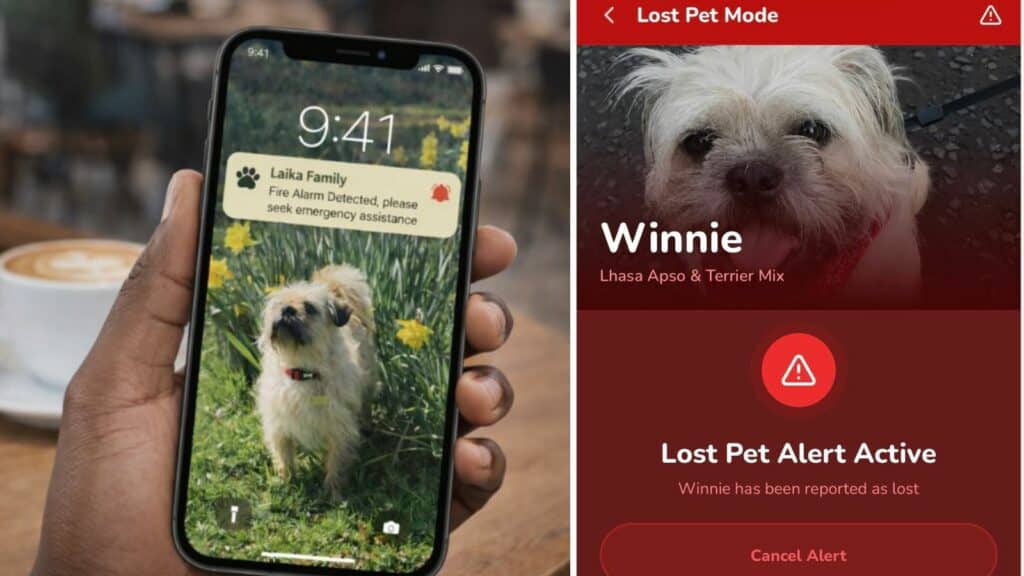
While demonstrating how it works, she adds: “Users would fill out an emergency animal card when signing up for the app, and all this data will then sit quietly in the background in our database. Fire and rescue teams will only see it if our device detects the fire, and then basically our device speaks to the database.”
‘It’s stopping them from doing their jobs’
Although Laika Family’s solutions are still in development, she says the company is preparing to launch an app-first MVP for the first pilot, before bringing in the smart device.
With over 78 people on the waiting list with more potential customers being “incredibly receptive” during focus groups, she highlights just how big the market opportunity is with over 17.2 million households owning a pet.
And according to recent research by MoneySuperMarket, spending on pets and pet-related goods has now jumped from £2.9 billion in 1997 to £11.95 billion in 2025.
“People love pets. We love buying things for pets and making them feel good and special and spoiled. Then there is that sombre feeling of: ‘okay, well, we have to think about their safety as well’ and that’s where we come in and support that.”
Laika Family is also attracting interest beyond pet owners.
“A firefighter I spoke to in January had to have a skin graft after being bitten on the arm while trying to rescue a dog,” she explains.
“Currently, there is nothing for fire emergencies when it comes to pets. The temperament thing really stuck for me, so when firefighters are saying they are getting bit, it’s stopping them from doing their jobs.”
Some of that feedback has led to the start-up now exploring partnerships not just with emergency services, but also postal and delivery workers, care providers and other organisations where staff regularly enter people’s homes.
It follows recent stark statistics from Royal Mail on 6 July, revealing 2,019 dog attacks happened in the year from the end of March 2025 to the end of March 2026, meaning an average of 38 attacks take place every week across the UK on postal workers.
And approximately 1,000 workers have lost a finger or part of a finger through letterbox attacks over the past decade.
“One thing that we can do is support our frontline and essential workers with information they need before they go to an address about pets there. If the dog doesn’t like strangers, the pet profile would show that, so they know how to safeguard themselves. By doing that, it helps them, but it also saves the pet’s life and avoids them being put down.”
‘I want this to be the gold standard for pet safety’
Like many founders, turning her vision for pet safety into a reality has been far from straightforward.
She has bootstrapped the business while taking part in several accelerator programmes, and although she was full of praise for that support, she believes there remains a ‘significant’ funding gap for founders at the earlier stages.
“I think the biggest thing for me is that I’ve built a community around myself that has been able to support me on this journey, but when it comes to more institutional funding and grants, there is a massive gap there and nobody is talking about it.
“If they are talking about it, it’s just conversations that don’t really go anywhere. People do have the best intentions, but then nobody has the practical tools to actually help.”
She would also like to see more pots of funding and better allocation of that funding when it comes to getting it into the hands of early-stage founders.
But despite some of those initial challenges, she’s continuing to have conversations with investors while focusing on launching the first version of the app, growing the waiting list and continuing conversations with emergency services and frontline organisations.
And looking further ahead, she has big ambitions for her start-up.
“We’re trying to build something in Manchester. I’ve always said that. The city has given me so much. This is where I started my business and had the idea and I want to keep it based here,” she explains.
“I want it to be an accessible brand and the gold standard for pet safety.”