
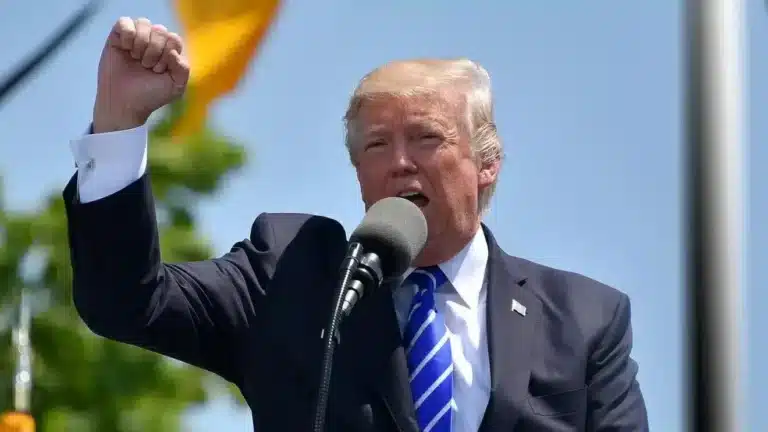

Analysis of more than 48,000 broadcast reports reveals how Donald Trump‘s controversial World Cup red card intervention has driven global conversation, and left football’s governing body facing what could generously be described as a communications challenge.
Trump’s intervention to overturn the US striker Folarin Balogun’s red card ahead of their last-16 clash with Belgium generateworld cup,d more than 50,000 television and radio reports worldwide between 5 and 7 July, according to analysis by Be Broadcast’s Mission Control tool. The story began with a President stepping into a football tournament, but quickly became a discussion about whether football’s governing body could remain independent once political interference entered the picture.
The analysis examined 25,513 broadcast reports from the United States alongside 27,507 reports from broadcasters across the rest of the world. While every market covered the same event, broadcasters reached very different conclusions about who deserved the greatest scrutiny.
Trump dominated American media, but not in a good way
Donald Trump remained the central figure throughout American coverage, appearing in 73% of reports. The intervention ensured the story became part of the domestic political agenda, but it did not generate favourable coverage. Just 7% of Trump-related reporting carried a positive tone, while 35% was neutral and 58% was negative or sceptical. Broadcasters questioned whether a sitting president should intervene in a football disciplinary process and whether politics had crossed into sport.
The finding is an important distinction from a communications perspective. Trump succeeded in making himself the subject of the conversation, which he’s sure to like. But he did not shape how that conversation was judged, which he won’t.
Internationally, the spotlight hit FIFA
Ouside the US, broadcasters established that Trump had intervened but quickly shifted their attention towards FIFA. The debate became less about why the President had become involved and more about whether football’s governing body had demonstrated the independence expected of an international sporting institution.
Mission Control identified more than 1,700 references to intervention, 1,100 references to controversy, almost 500 references to politics and more than 430 references to independence across international coverage. Scepticism was the dominant editorial tone, with broadcasters repeatedly examining the integrity of FIFA’s processes rather than Donald Trump’s motives.
The scrutiny moved from the politician who created the story to the institution expected to withstand political pressure.
Reputational questions for FIFA
The international coverage rarely accused FIFA of direct wrongdoing, rather questioning whether the organisation had protected the appearance of independence. That distinction matters because reputational challenges are often driven simply by confidence in a process rather than proof that the process has failed.
The timing adds another intriguing subtext. FIFA President Gianni Infantino is himself due to stand for re-election in 2027. In the football world, UEFA has publicly described the Balogun decision as “unprecedented, incomprehensible and unjustifiable”, and FIFA’s own statutes prohibit political interference in football. Nor was the Balogun intervention the sole example of political interefence in the 2026 competition, although it may have been the highest profile to date. Previously, the US administration prevented a section of the Iranian team from getting visas and refused to allow the rest of them to stay on US soil between games, blocked a Somali FIFA referee from entering the country, and denied visas to fans from Muslim or other third world countries. Those actions were blatantly political and violated the spirit of the tournament, yet FIFA was silent.
What about the football?
It’s easy to forget amidst all the predictable Trump attention seeking that there’s actually a football tournament at the centre of all the drama, and the beautiful game has at least starting to make some headway in reclaiming the narrative, not least because the previously uninspiring Belgian team put in a top drawer performance against the, let’s call it what it is, cheating US to deliver a solid 4-1 thumping even with a banned star player on the field.
During the first phase of coverage, the match was secondary to the political controversy. In the United States, only 6% of football-related reporting carried a positive tone, while 39% was negative as broadcasters concentrated on the intervention, FIFA’s decision and Team USA’s elimination.
The 4-1 win changed the editorial direction. Had the United States progressed, broadcasters would almost certainly have continued asking whether political influence had altered the tournament. Instead, the result allowed many broadcasters, particularly in Europe and South America, to return their attention to Belgium’s performance, the competition and the football itself.
The story also revealed some very different editorial cultures, and Mission Control found that broadcasters were divided less by geography than by the questions they chose to ask.
Across Canada, the UK, Australia, New Zealand and Ireland, coverage focused heavily on process. Broadcasters spent considerably longer examining Trump’s intervention, the disciplinary process and whether political influence had affected FIFA’s decision-making.
Across much of continental Europe, the intervention felt almost unsurprising and Trump was given minimal attention – perhaps an indicator of the regard Trump is held in here – with coverage quickly moving onto Belgium’s performance and the tournament itself.
Across markets in both Europe and South America, broadcasters showed a consistent instinct to judge the institution rather than the politician. Coverage spent less time analysing Donald Trump personally and more time asking whether football had protected its own rules.
The closer broadcasters were to American politics, meanwhile, the longer Trump remained the story. The closer they were to football culture, the quicker attention returned to the game – one incident left different questions in different parts of the world
Mission Control also found that the same intervention produced very different reputational questions depending on the audience.
In America, the debate centred on whether the President should intervene on behalf of the national team.
Across much of Europe, the discussion became whether FIFA should resist political pressure regardless of where it came from.
Within football-first markets, the lasting question became whether a precedent had been created and whether every nation would be treated equally in future, a question which seems likely to extend beyond one red card and stretch into the way future decisions are interpreted.
Josh Wheeler, founder of Manchester-based Be Broadcast, said: “One of the assumptions we often make in communications is that the person who starts a story owns the reputation that follows. This analysis found something different.
“Donald Trump dominated the American agenda, but internationally he stopped being the main subject surprisingly quickly. Broadcasters accepted that he had intervened and moved their attention towards FIFA. From that point onwards, the debate became about whether football’s governing body had protected its independence.
“That’s a much harder communications challenge because institutions are judged differently from individuals. Politicians are expected to be political. Governing bodies are expected to be impartial.
“The other core element here was how different parts of the world defined fairness. American broadcasters largely debated whether the President should have acted, with the majority seeming to lean toward no. Many European broadcasters asked whether anyone should receive special treatment in the first place. They sound like similar questions, but they produce very different conversations.
“Belgium’s victory changed the communications outcome more than any statement or response could have done. Had the United States won, questions around political influence would almost certainly have followed the tournament. Instead, broadcasters gradually returned to the football, which is where many of them wanted the story to end.”