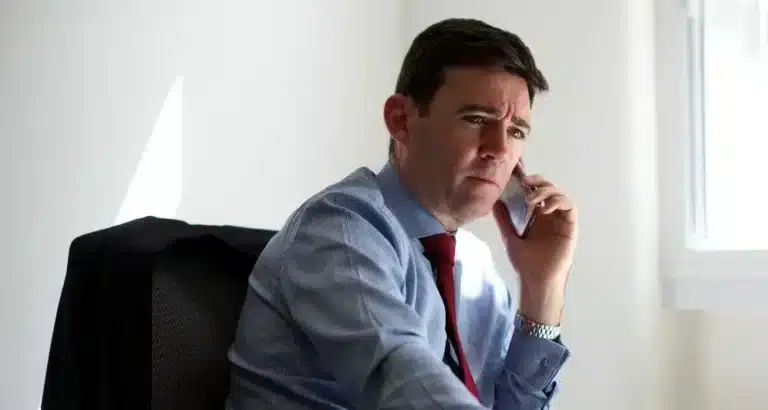

Former Manchester Mayor Andy Burnham has given the first major policy speech of his “campaign” for his seemingly inevitable march to 10 Downing Street in, where else, Manchester.
Among the items on his to-do list were the predicted “Number 10 North,” with some of Downing Street’s functions set to move to Manchester in an attempt to rebalance the London-heavy government machinery, increased regional devolution, and a “circuit breaker for a “broken” political system in Westminster.
Other tangible policy promises included plans to reform utilities, reindustrialisation and regeneration; the “biggest council house building programme in the post-war period”, and a vow to reform business rates to better support pubs and high street businesses, although with Burnham declining to take questions from journalists following his speech the details remain thin on the ground.
READ MORE: Liverpool Live’s departed Frankie Connor finds new home at Minerva Radio
Nonetheless, response seems to have been largely positive following his words, with UK government borrowing rates actually improving slightly despite his ambitions for what sounded like some fairly hefty structural changes in British politics, and the FTSE holding steady, albeit not exactly setting the world alight.
Local industry figures in the North have been largely responsive to his pledges too, with more powers for regions outside London a particular favourite. Chris Fletcher, CEO of North East commerce agency Visualsoft, said: “Andy Burnham is right to argue that regions should have a greater say in their own economic future. We love being based in the North East, with a team that lives and works here every day, and we’ve seen first-hand the talent, ambition and entrepreneurial spirit that exists outside London.
“Giving regions greater control over investment, skills and infrastructure could create even more opportunities, but only if it’s matched with the powers and long-term funding to make those decisions count. The North East has everything it takes to become one of the UK’s leading tech hubs, and businesses like ours will always benefit when decisions are made closer to the communities and employers they affect.”
Over at the Institute for Public Policy Research, Burnham’s pledge for a major shakeup was well-received too. Mirte Boot, principal research fellow and interim head at IPPR North, said: “Andy Burnham is right to call for bold, transformative change to our country’s economy. The writing on the wall is clear; the status quo isn’t working. People feel acutely that their places are not getting back what they’ve been putting in, and political trust is at rock bottom.
“For two decades, IPPR North has seen successive governments promise change, transport spending, and regional growth in the North. But to drive real change, we must turn the system on its head, and power must be handed down to people and places.
“Mayors must be given the powers and capital to build local infrastructure like transport and housing, and we must see a push against Whitehall orthodoxy, so local leaders are given control over revenue and borrowing.
“This cannot just be words anymore. We have to see delivery. Devolution is for the whole country: when our regions prosper, so does the UK. This is not about north versus south, it is action versus inaction.”
Joe Till, CEO of Manchester retail tech company One Iota, hoped Burnham could repeat the success he has had in Manchester on a national level: “Andy Burnham has consistently championed Manchester as a place to build, invest and innovate, and that ambition has helped put the city firmly on the map for technology businesses,” he said. “It’s got the reputation that it wanted, and is now a destination for innovation. The challenge now is making sure that approach is replicated across the country – and it sounds like it’s one he’s prepared to take on.
“Devolution works best when local leaders have the powers and long-term certainty to invest in the infrastructure, skills and innovation their regions need. We’re Manchester, we’re tech, and we’ve seen the value of having a strong regional voice. It just makes sense that if more places have the ability to shape their own economic future it will help unlock investment, attract talent and create the conditions for businesses like ours to grow, not just in the region, but across the UK and internationally. The roots might be Manchester, but the potential is global.”
Keith Griffiths, founder and CEO of The Entrepreneur Festival and exited founder of the massive real estate and regeneration shindig UKREiiF was understandably keen to pitch for the interests of the UK’s entrepreneurs: “It is encouraging to hear Andy Burnham’s commitment to making Britain an ‘innovation nation.’ But if he is serious about delivering growth in every postcode he must start with the people who create growth: entrepreneurs,” he insisted. “His speech touched on the importance of backing entrepreneurs, but the real test will be turning ambition into concrete policies that make it easier to start, scale and exit a business. Every successful company begins with someone willing to take a risk, create jobs and invest in their community. Now it is time for the government to support those entrepreneurs on every step of their journey.”
In PR World, Josh Wheeler, founder of Be Broadcast, was pleased to see Burnham move the narrative away from the “King of the North” and Londin vs Manchester narrative that has dominated much of the capital’s coverage of Burnham’s rise: “From a communications perspective, what interested me most wasn’t actually the policy. It was the narrative,” he said.
“For the last week, we’ve heard people frame this as Manchester versus London. Burnham didn’t lean into that. In Manchester, he described London as ‘the world’s greatest capital city’. That changes the conversation completely. The message wasn’t that London has had too much. It was that more places should have the opportunity to succeed. That’s a much more unifying story.
“Manchester has become the proof that investment outside the capital can transform a place. You only have to look at what the BBC’s move to Salford has done for the creative industries. MediaCity didn’t just create television studios. It created confidence, attracted businesses, built careers and changed how people see the city.
“What’s interesting is that Manchester has never really wanted to become another London. I remember campaigning against Channel 4 moving here. Not because I didn’t want the jobs, but because Manchester had already benefited from major investment. The next opportunity should have gone somewhere else. One successful city should help create the next one.
“That’s what I hear when Burnham talks about Manchesterism. It isn’t about building a mini London in the North. It’s about proving you don’t need to be London to succeed.
“There’s also something powerful about Manchester’s identity. The city has always been comfortable as the challenger. Whether it’s industry, music, football or broadcasting, Manchester has often defined itself by proving people wrong. Even Donald Trump’s throwaway comment about Manchester being ‘some town’ feeds into that story. Cities, like brands, are often shaped as much by the stories they tell about themselves as the buildings they build.
“For communicators, that’s probably the biggest takeaway from this speech. Burnham wasn’t simply announcing policies. He was trying to create a national story that people in Birmingham, Newcastle, Cornwall, Norfolk or Glasgow could see themselves in. That’s much harder than delivering a list of announcements.
“I grew up in the West Midlands, studied and worked in London, and founded my business in Manchester. Listening to the speech, what stood out wasn’t Manchester’s ambition. It was the sense of hope. British life has felt short of that for a long time. If even part of this vision becomes reality, it could change how places across the UK think about their own potential.”
In Scotland, Leith MD/CEO Richard Marsham was also keen to look beyond the “London vs…” tropes, although like the journalists who had made the rare trip up North he would have liked a bit more detail: “It’s too early to judge whether Andy Burnham’s speech will benefit us as an agency. It was big on rhetoric but light on detail and, like many speeches about ‘overhauling government’ and delivering radical change, my first thought is always: who’s going to pay for it, and how long will it take before it delivers any meaningful impact,” he observed.
“At Leith, we’ve always positioned ourselves as a top UK creative agency that just happens to be based in Edinburgh. We love competing with London’s best. The “regional agency” label is one we’ve never wanted to lean into. Choose us because we’re the right agency, not because of our postcode.
“There’s no doubt some sectors still struggle to look beyond London when selecting an agency, but others are far more open-minded. We now work with a long list of European-based multinational clients, particularly in healthcare, where geography has rarely been a barrier.
“Looking back over my 20 years at Leith, regionality and the concentration of power in London haven’t felt like the biggest challenges. The far greater change has been globalisation and the consolidation of huge multinational companies, which have acquired large numbers of family businesses and independent brands. The pool of clients available to agencies like ours has shrunk dramatically since I started my career, and today many of the largest multinational briefs are only seriously contested by agencies within the major global networks.”
He concluded: “London hasn’t been our biggest challenge. Consolidation has. The real divide in our industry isn’t London versus the regions – it’s independent agencies versus global networks.”