

Lancashire doesn’t need a single identity to drive its economic growth, but it does need cohesion — and a “visible” figurehead might be the answer.
That’s according to a group of leading tech and digital leaders across the county, who came together on 12 November for a roundtable hosted by Prolific North in association with Forbes Solicitors to discuss how to drive Lancashire’s growth, as part of a dedicated focus week.
It was one of the most ‘round’ roundtables we’ve ever attended — and, thankfully, unlike on The Traitors, no one was banished for speaking their minds.
The first part of our coverage today focuses on where Lancashire is heading and how tech and digital businesses can lead the charge. Tomorrow, we’ll be exploring how people, skills and investment underpin that vision.
Attendees
- David Prior, Partnerships editor and event chair, Prolific North
- Daniel Fletcher, Senior associate, Forbes Solicitors
- Ben Hookway, CEO, Relative Insight
- Claire Lambert, Marketing and comms lead, Innovate Lancashire, Lancashire County Council
- Dan Knowles, Founder, Lancashire Digital Hub
- Lee Petts, Founder and chief idea haver, 52M Consulting Ltd t/a Fifty2M
- Martin Meadows, MD, Workhouse Marketing
- Nathaniel Cassidy, Founding partner and chief punk, 3manfactory
- Rob Ellis, Managing director, Two Stories
- Rory Southworth, Fhunded Angels – Manager, Fhunded
- Sam Fletcher, Managing director, 21Digital
- Simon Couchman, Managing director/Creative director, ICG
- Tom Grattan, Managing director, EXP
What’s Lancashire’s identity?
Daniel Fletcher (Forbes) kicked off the event by praising the “strength” of Lancashire’s digital and tech sector before the conversation quickly turned into a lively debate on the county’s identity.
Nathaniel Cassidy (3manfactory) questioned the need for a “single unique value proposition”: “There’s a lot of benefits to doing business here, but I’m not convinced Lancashire needs a fully unified identity.” Lee Petts (Fifty2M) added that “no one has nailed down what Lancashire’s unique value proposition really is.”
Lancashire’s core strengths lie in advanced manufacturing and engineering, while cybersecurity and energy are “growing sectors for the region,” explained Dan Knowles (Lancashire Digital Hub). Cassidy (3manfactory) suggested that rather than trying to reduce the county to a single proposition, the focus should be on “making that diversity an advantage through better coordination.”
“We don’t necessarily need a singular truth but we do need a way to bring an element of cohesion to a wide narrative. We need to stop framing this as a positioning problem and start seeing it as a coordination opportunity.”
Simon Couchman (ICG) highlighted the “clusters” across the county attracting “great talent,” emphasising that businesses can thrive outside major cities. Rory Southworth (Fhunded) pointed to a growing deeptech scene emerging from university spinouts. While Lancashire lacks major venture capital houses, outside investors are increasingly familiar with the businesses thriving there.
From an agency perspective, Couchman (ICG) described a “really strong creative sector,” serving global clients rather than competing locally. Rob Ellis (Two Stories) said around 80% of his clients are based outside the county, while Sam Fletcher (21 Digital) noted his agency has built up a strong local client base.
The discussion turned to why Lancashire-based businesses often don’t use local agencies.
Petts suggested there’s “more appetite for agency support” outside the county, while Tom Grattan (EXP) explained that large companies in the region, particularly in defence, often rely on in-house teams due to government checks.
He also questioned whether Lancashire needs a “unified story,” noting there’s “no central place for creatives to come together.” Daniel Fletcher (Forbes) added that the county’s geography and lack of a central hub contribute to this fragmentation.

Some of the leaders pointed to Manchester Digital’s consistent strategy as a model for regional coordination, while Sam Fletcher (21 Digital) highlighted that although Lancashire “doesn’t have a brand like Yorkshire,” its business culture is defined by “honesty, integrity and transparency.”
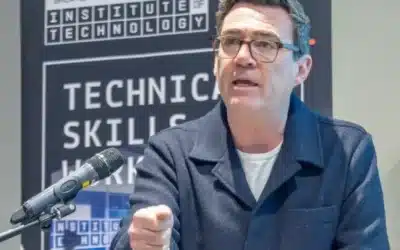
Does Lancashire need a Burnham figure to steer growth?
Although Lancashire’s brand has historically been about innovation, Petts (Fifty2M) observed that over the past 50 years: “It has become good at managing decline, rather than investing in growth.”
Using Andy Burnham as an example of a mayor who has successfully “beat the drum” for Greater Manchester, several leaders suggested that a central figurehead in Lancashire could be key for future growth.
The topic is timely: there has been much debate over Lancashire potentially joining other Northern regions such as Greater Manchester and the Liverpool City Region in having an elected mayor, following the establishment of the Lancashire Combined Authority earlier this year.
This ‘need’ for coordination sparked a wider discussion about governance and visibility. “A figurehead or mayor could make Lancashire more visible and coherent,” explained Cassidy (3manfactory). With so many cultural differences and specialisms across communities from Lancaster to Blackburn, Southworth (Fhunded) questioned whether a single figure is needed, but agreed there should be more opportunities for people to connect.
“We’ve done exceptionally well without having a mayor and being in quite a rural place, because we have great talent, great businesses that are resilient and just get on with it.”
Claire Lambert (Innovate Lancashire) noted that with “great stories” across the county, it’s difficult to establish a single “central place,” as each area has its own unique narrative.
Summarising the argument for coordination, Cassidy (3manfactory) said: “We need a ringmaster helping to coordinate investment priorities, communication, and identity in a way fragmented governance structures can’t.”
“Private sector businesses, education institutions, and media outlets like Prolific North can all play a part in cohesion, but a mayor or central voice would make the county’s identity flesh. Someone people can actually see, meet, relate to and rally behind. People buy from people, as the saying goes.”
When everything is “fragmented and made up of smaller players,” Lancashire lacks a regional leader or figurehead that can “lobby and push” the government for investment, said Martin Meadows (Workhouse Marketing). Grattan (EXP) called for more focus on “place branding,” emphasising that Lancashire’s rich 200-year history of innovation needs to move forward and showcase its strengths.
Petts (Fifty2M) questioned the practical advantage of a stronger narrative, while Grattan (EXP) noted that “political fragmentation” over the past 10 to 15 years has left Lancashire “chasing the next big shiny thing”. A central figure could provide continuity and act as a focal point for long-term economic strategy rather than constantly shifting attention between projects.
Finally, Petts suggested a Blackpool-based event similar to Brighton SEO could be a “significant” opportunity for the region, though others debated whether there is a venue large enough to host it.
Innovation, technology, and infrastructure
The leaders then turned their attention to the role of networks and digital infrastructure. Digital connectivity and transport remain “a big problem,” yet Ben Hookway (Relative Insight) said positioning Lancashire as having a train link to London “shouldn’t be resisted,” calling it a “big advantage.” He added: “If you have a company that’s really going for a global market, the less relevant your home place is.”
From the planned Silicon Sands development in Blackpool to Fraser House in Lancaster, “innovation” is emerging across the county, though it remains concentrated in certain areas, explained Knowles. “Over the next few years, we’ll start to see people gravitating towards these hubs as the key places in Lancashire to do innovative work.”
Lancaster, with a top-10 UK university producing spinouts alongside skilled digital, creative, and marketing agencies, “has worked really well” as a case study on how a digital and tech hub can “anchor everybody together” rather than forcing innovation, Knowles (Lancashire Digital Hub) said.
A willingness to travel across the county is a “big issue,” said Ben Hookway (Relative Insight). Drawing on his experience of working in Silicon Valley, he explained that it can take up to three hours to travel across the region yet in the UK, travelling from somewhere like Manchester to London is often seen as a major obstacle.
Despite some of the challenges raised across the morning event, Southworth (Fhunded) said Lancashire’s digital and tech businesses are thriving: “We may lack a narrative or other bits, but as businesses in the region, we’re smashing it — and we’re probably more resilient for it. Everyone around this table seems to be a success.”
While challenges clearly remain, whether it’s infrastructure gaps or fragmented governance, all of the leaders were optimistic about Lancashire’s opportunities. Tomorrow, we’ll continue our roundtable coverage with a closer look at how talent, emerging technologies and renewed investment in skills could shape the county’s future vision — and help overcome the obstacles standing in its way.