

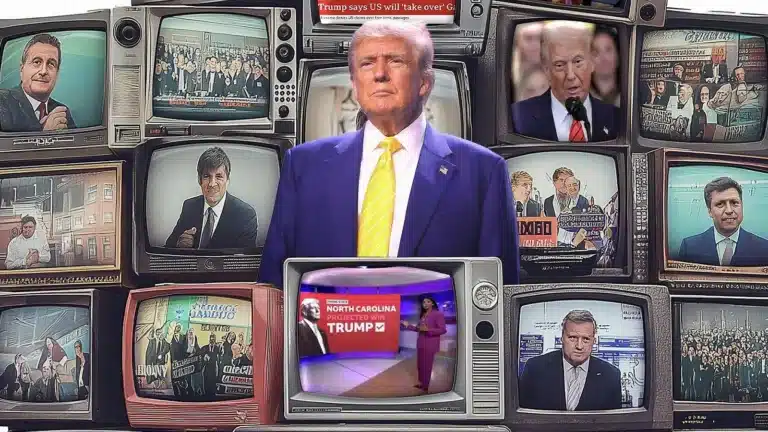

“We’re gonna walk down to the capitol,” said Donald Trump after his defeat in the 2020 US general election. 54 minutes later he added: “I’ll be there with you, and we’ll fight. We’ll fight like hell.”
As you’ve probably heard by now, October Films, the makers of the 2024 BBC documentary Trump: A Second Chance? Chose to splice these sentences together, resulting in what could probably be reasonably described as a misleading quote and now, five years after Trump’s speech, the resignation of the BBC’s director general and its head of news, and a threat from the US reality TV star-turned-world’s most-powerful human to sue the BBC for $1bn for defamation.
So, could the host of The Apprentice US succeed where homegrown PR disasters like Jimmy Saville and Huw Edwards have so far failed, and bring the UK’s national broadcaster to an end, no doubt delighting his biggest fans, who coincidentally tend to include the BBC’s biggest critics, in the process?
Legally at least, this seems unlikely. UK law requires defamation action to be launched within a year of the alleged defamation taking place, so Trump’s sudden interest in the ageing documentary appears to have missed the boat on that front. Steve Kuncewicz, a partner at Manchester law firm Glaisyers, noted on LinkedIn: “Not sure, based on a Letter Of Claim drafted by a US Lawyer with no reference to UK Civil Procedure and asking for relief going far beyond what our Courts would order in a case where limitation’s likely expired without convincing the court otherwise, that Trump v BBC goes the legal distance, at least in the UK. His last claim here didn’t make trial either. Here’s hoping that, if only in this jurisdiction, the Court Of Politics and Public Opinion doesn’t set a very dangerous precedent.”
That won’t stop Trump’s fan club from calling for the broadcaster’s head though. Reform UK leader Nigel Farage, a high-profile BBC abolitionist, somewhat ironically given the amount of free advertising the broadcaster gives him, told notoriously impartial Talk TV host and Reform campaigner Jeremy Kyle, whose Manchester-based flagship ITV show ran for 14 years before its cancellation in a maelstrom of controversy in 2019, that the BBC’s coverage of topics from the EU to climate change, Gaza and of course Trump “has not been impartial” and is “so biased it doesn’t even know it’s biased.” The corporation, he suggested, should be “pared back to just doing news at a local and national level” and that the “current subscription model is completely outdated.”
Offering a somewhat more nuanced take, Richard Jones, director of journalism at the University of Salford told Prolific North: “There’s a running joke in the media that every story eventually turns into a row about the BBC.”
He continued: “Even by its own standards it’s been a turbulent week for the BBC. Just days after winning huge ratings for Celebrity Traitors, it’s lost not one, but two, top executives. Director general Tim Davie and news chief Deborah Turness have quit after a Panorama documentary included a misleading edit of a speech by Donald Trump. Davie is the fourth Director General in my lifetime forced to resign because of a political row about mistakes in the BBC’s journalism. Each past leadership crisis has led to a change of course, with lower-profile, more risk-averse bosses appointed to steady the BBC ship. But this time the fix looks harder than ever, as the BBC faces a growing number of serious challenges.
“The intensely polarised political landscape has put its traditional impartiality under strain. Meanwhile, the corporation has failed to stop damaging revelations about itself, from Huw Edwards to Glastonbury. Which brings us to trust. Overall faith in news companies is down 15% in the last decade, although the BBC remains the most trusted brand in UK news media. But that is not enough to stop people spending time and money with global streaming platforms instead. Just last year another 300,000 households stopped paying the BBC licence fee altogether.
“Tim Davie’s successor will be the one forced to navigate not only Trump’s threatened legal action, but the charter process to decide how the BBC will be paid for in future. There is no shortage of calls to turn the BBC into a leaner subscription service, at least in part. Although, as past attempts to close services from BBC Three to BBC6 Music tell us, scrapping even relatively small parts of the corporation can run into stiff opposition.
“Yet with Sky owner Comcast eyeing a potential takeover of ITV’s channels, the whole shape of our system of public service broadcasting is now in question. These traditional titans of British media have already been finding it tough to fund the production of high-quality domestic shows. A weaker, poorer, BBC would struggle to make the next Celebrity Traitors, let alone provide comprehensive news coverage across all its platforms. And that’s no joke.”
For the BBC itself, the latest drama represents yet another exercise in crisis management. Tom Houghton, news & outreach director at search-driven content agency No Brainer, notes that the BBC should perhaps be more concerned with its reputation than any financial threat from overseas:
“To say the BBC is in a tough spot would be an understatement, with this being the latest in a list of recent crises,” he said.
“Trust is the foundation of any broadcaster’s relationship with its audience – particularly one like the BBC – and once that starts to wobble, people want straight answers and visible accountability.
“The talk of legal action has driven the story today, but the real challenge for the corporation is reputational. When questions start being asked about accuracy and judgement, confidence can slip quickly, especially in a fast-moving news cycle.
“Credit where it’s due, the resignations show an understanding of how serious this is. What matters now is how the organisation communicates from here. People respond to openness and a willingness to learn from what’s happened.
“The learning for others is that crisis planning can’t just live in a drawer. A strong internal culture of accountability, clear sign-off processes, and a readiness to front up when things go wrong and the confidence to communicate early before speculation fills gaps, all help build resilience.
“Audiences notice when there’s honesty and clarity. They also notice it when there isn’t! Keeping communication human and consistent gives you the best chance of rebuilding belief over time.”
There was also support for the Beeb from former World Service journalist and OpenDemocracy editor, and current Goldsmiths University journalism lecturer Rashmee Rohan Lall. Writing on her blog, the seasoned journalist left little doubt over who had most to gain from any legal action against the BBC: “If Mr Trump is true to form, he will sue the BBC for a sum that will make it difficult to function,” she said
“If any such cash transfer were to occur – from the BBC to Mr Trump – it would be upsetting in the extreme. Here’s why: The BBC made a mistake in commissioning a piece from an external provider with an apparently slippery sense of the rights and wrongs of video splicing! That’s a mistake, an error of judgement in trusting that external provider. It doesn’t call all of the BBC’s journalism into question.
“But Mr Trump and the global populist right would like to grind a public service broadcaster into dust. The result would be the sort of polarised, fragmented media landscape that currently exists across the United States.
“How does that help anyone, other than the global populist right?”