

Suranne Jones has taken on what she describes as her most pressured role yet, playing UK Prime Minister Abigail Dalton in Hostage, Netflix’s new political thriller.
The Middleton-born actor – who attended Cardinal Langley RC High School and first appeared on UK TV screens as Karen McDonald in ITV’s Coronation Street in 2000 – stars opposite Julie Delpy as French President Vivienne Toussaint. The series sees the two leaders form an uneasy alliance during a London summit after the prime minister’s husband is kidnapped, working together to unmask the kidnapper and a blackmailer.
READ MORE: BBC must be beyond ‘chilling’ reach of politicians, ex-boss claims amid Bob Vylan row
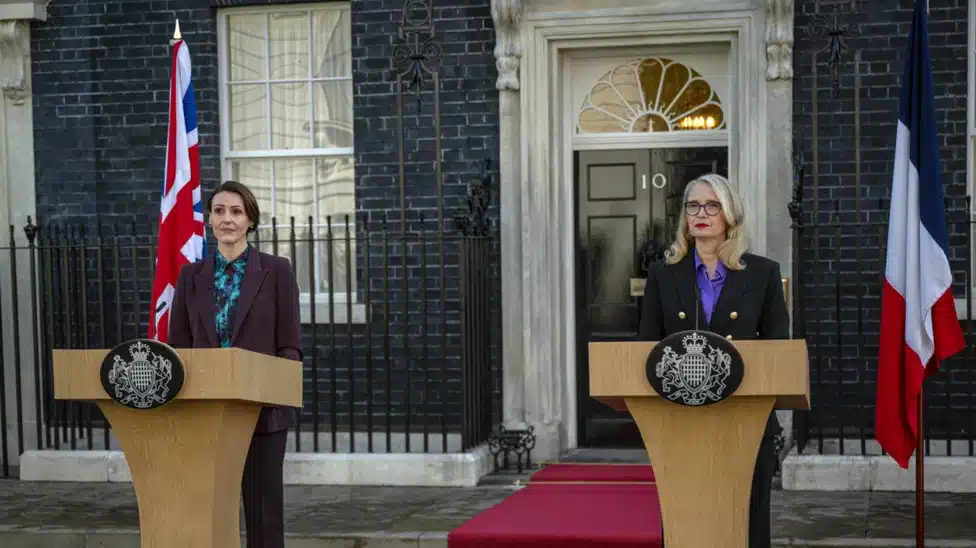
Audiences may be tempted to connect Hostage to today’s headlines, but Jones says the show is more interested in thrills than direct parallels. “We’re entertaining and we’re in the political world, but it’s in no way a reflection of the world we live in,” Jones tells the BBC. “It’s political with a small p – there’s enough that roots us in the real world but the world is too complicated to link it directly and I think it would be inappropriate.”
Writer Matt Charman says the series inevitably brushes against real-world concerns while carving out its own space. “If you wrote a show that isn’t connected to our world it would feel weird,” he says, “but I hope the show does have the ability to exist in its own oxygen.”
Charman adds that making both heads of state women was central to the concept. “What was exciting was the idea of women in power and how we explore that,” he says, explaining that he tried to explore how each situation the characters face would be different for a woman. “There’s a double standard for women, so giving full dramatic freedom to that was very important.”
Jones says she particularly enjoyed exploring “how these two women have to dance around each other”. She said: “A female politician is used to dealing with men so it’s interesting to see how it plays out when it’s two women.”
Delpy said: “We made sure not to play into the female politician stereotypes,” and “What I like is that these women actually have some things in common like they both want change and came into office hopeful.”
To play Dalton, Jones immersed herself in the realities of political life. “I’m a bit of a geek when it comes to research,” she says. “I was fascinated by not emulating anyone but by understanding a life I knew nothing about. And it’s the cost of being in a powerful position in that way that really struck me.”
Charman says the team spoke to people with first-hand experience of high office. “We interviewed a lot of people and Suranne had incredible access to people who had been prime minister who talked about their time in office and the pressure on their family. But it was all agreed that they would speak about this as long as it could remain confidential,” he says.
Jones won’t name specific inspirations, but says previous roles remain part of her toolkit — a “boardroom of personalities” she draws on. She adds that researching political life “changes your perception for sure” and makes you realise “the cost of being in a powerful position”.
For Charman, the heart of the series is the moral strain of leadership. “I wanted to explore how there can be decent people in politics who are fundamentally good but get pushed around,” he says. It isn’t “inevitable” that politicians abandon their ideals, he argues, but “it’s definitely tough to keep your morals”.
Delpy is more sceptical about moderation cutting through: “politicians have to be heard, if you’re too reasonable you won’t be listened to as there’s so much noise of both extremes”. “If you have a moderate view you get lost in the noise as people are only listening to the loudest.”