


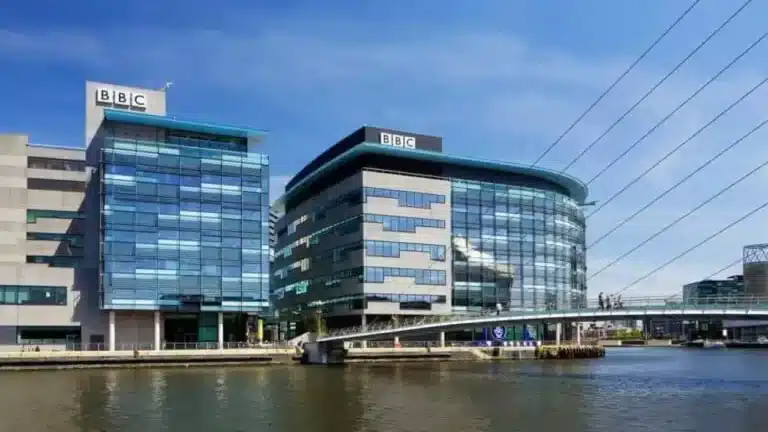

The scale of the BBC’s planned cuts – up to 2,000 jobs and £500m in savings – has triggered concern not just for the broadcaster itself, but for the wider UK creative and journalism ecosystem it underpins.
Staff were informed of redundancies during a 3pm call on Wednesday. One staff member who was on the call said: “I mean, it was savage. They have not outlined how or where these jobs will be cut and it’s just caused huge panic.”
While the corporation has framed the move as a response to “significant financial pressures”, industry voices are warning the impact will ripple far beyond the BBC, particularly across freelance and independent production communities and local journalism industries which are already under strain.
READ MORE: Why the AI search panic may be missing the point for brands and agencies

Earlier this year, Prolific North’s focus week examining the state of the Northern TV and film workforce painted a stark picture of an industry many described as being “on its knees”, with freelancers quitting, indies scaling back and a growing sense that the current model is no longer sustainable.
That backdrop has sharpened concerns about what a smaller BBC means in practice now that it has announced up to one in 10 jobs will be cut in its biggest downsize in a generation.
Culture Secretary Lisa Nandy struck a note of support, telling BBC Radio 4’s World at One yesterday: “This Government believes in the BBC, and we think it is one of the two most important institutions in the country. The NHS looks after the health of our people, and the BBC is one of the greatest defenders of the health of our nation.”
But others point to deeper structural challenges and long-term consequences for the UK’s media and creative landscape.
Rob McLoughlin, chairman of Prolific North, highlighted a pivotal moment in the sector’s history. “In 2009 the BBC wanted to combine with ITV and C4 to create a new bespoke streaming service called ‘Kangaroo’ which would have been ahead of many US streamers. OFCOM said No. That 2009 decision was potentially a ‘death sentence’ for the PSBs (Public Service Broadcasters).”
He added that while production arms have adapted by selling into global platforms, the underlying funding model remains under pressure. “Unless that is matched by a funding mechanism which is innovative and by intense ‘commercial’ activities by the likes of BBC Studios then it’s hard to see how the public will be willing to pay higher and higher fees to fund the BBC,” he said. “Many are already refusing to pay.”
Freelancers already at breaking point
For many working in TV and film, the concern is immediate. Prolific North’s reporting found freelancers facing longer gaps between work, falling rates and an oversupply of talent chasing fewer opportunities — a situation some warned could worsen if BBC commissioning and spend are reduced.
Manchester-based producer Nadia Jaynes, founder of Little Monk Pictures, previously warned that without sustained investment, the North risks becoming a “training ground” rather than a viable long-term base for careers. “If we want to retain talent in the North, we have to reinvest, upskill and have a long-term plan for where that talent goes… otherwise, people… realise that to have a sustainable career, they have to move south or leave altogether,” she warned.
Others questioned whether the industry can continue to sustain the volume of new entrants at all, with one producer describing a system where “the jobs don’t exist” and work is “slowly drying up”.
At the same time, independent production companies are grappling with shrinking budgets and shifting commissioning models.
Cat Lewis, CEO of Nine Lives Media, described a “seismic change” as viewing habits shift and advertising revenues decline. “It’s no surprise that terrestrial channels are struggling,” she told Prolific North. “We are in the middle of a revolution. What we should be asking is, how do we change?”
An “anchor” under strain
Across the industry, reaction to the BBC cuts has focused on the role it plays as a stabilising force. Social media manager Ezeabata Favour Ijeoma said the move should act as “a massive wake-up call for the entire creative sector”, warning: “While the 10% cut is the headline, the ‘6th thing’ we should be watching is how this impacts the regional creative economy that the BBC has historically anchored.”
Leadership author Jean Pierre Mugenga described the announcement as a generational shift. “Up to 2,000 jobs will disappear,” he said. “One in ten roles. The largest cut since 2011… the moment the ground shifted beneath the institution.”
He added: “Our funding model has reached end of life.” And warned of the wider consequences. “The regional creative ecosystem has always relied on the BBC as an anchor,” he said. “Remove that anchor and the tide pulls talent toward YouTube-first creators and AI-accelerated independents.”
That shift is already being felt. Jyothish Nair, a doctoral researcher in AI strategy, said: “Competing with global streaming budgets will require a completely different commercial foundation.”
A shrinking centre of gravity
For decades, the BBC has acted as both commissioner and cultural benchmark supporting freelancers, sustaining independent production companies and anchoring regional creative economies.
Its investment has been significant. The corporation has previously said 93% of its development spend goes to indies, with more than a third of network TV spend outside London.
But as commissioning slows and budgets tighten, the risk is that an already fragile ecosystem becomes harder to sustain.
Former BBC journalist Giovanni Ulleri described the cuts as more than a financial reset. “It feels like the end of something bigger,” they said. “A version of the BBC where people could build whole careers… shaping ideas that defined broadcasting itself.”
Rob McLoughlin pointed to areas where the BBC still retains strength, particularly trusted news and regional output. He said: “On many weekday nights BBC1’s highest audience is for regional news – it’s bespoke and helps to fulfil a local need.”
But with funding under pressure, the corporation may be forced to focus more tightly on those “winning areas”, while scaling back elsewhere.
An existential moment
The longer-term question is not just what the BBC cuts but what happens to the system around it. Prolific North’s focus week highlighted an industry already grappling with structural change: the rise of streamers, the dominance of global platforms, and a freelance model many say is no longer fit for purpose.
If the reaction to the latest cuts is to be believed, the BBC’s retrenchment risks accelerating those trends — from talent drift to platform fragmentation — at a time when public service broadcasting is already under pressure.
As Jean Pierre puts it: “How much can be cut before the BBC becomes something unrecognisable to the nation that built it?”


