


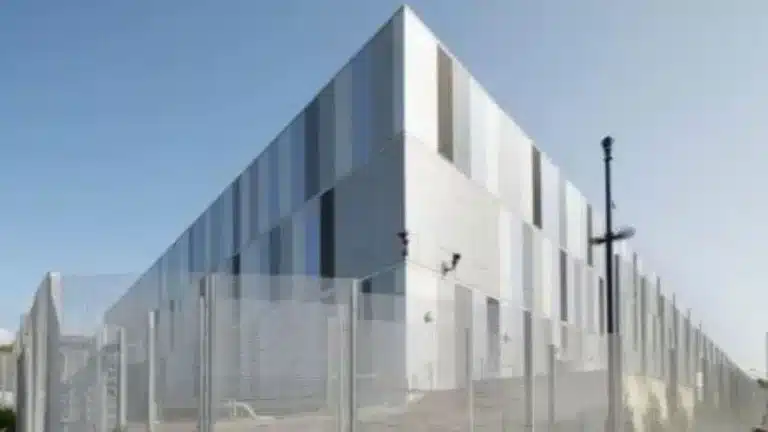

A huge Scottish datacentre development has misrepresented its plans to channel a nuclear reactor’s worth of power to a site in rural Scotland, according to a new Guardian investigation.
When the £8.2bn AI datacentre complex in Lanarkshire was announced in January, built by the US firm CoreWeave and the Scottish company DataVita, the government promised that it would be powered entirely from on-site renewables and built by 2030 – indeed, a central plank of the viability of the project, designed to help with Britain’s ambitions to keep up in the global AI race, was its ability to power itself.
CoreWeave, meanwhile, claimed that CoreWeave Lanarkshire would become “one of the most advanced AI sites anywhere in the world” following the completion of their plans.
READ MORE: Sky’s £1.6bn ITV takeover deal finally made official
Documents obtained by The Guardian under an FoI request, however, suggest the datacentre has virtually no chance of meeting that goal.
Internal correspondence obtained by the paper, however, suggest that the government and the site’s developers were privately acknowledging that the site had an “issue” with “power provision” and that this would not happen, even as they publicly promised that the Lanarkshire site would have up to 1GW of “new energy infrastructure”.
The government told The Guardian that the Lanarkshire complex would connect to the national, meaning it would join a years-long queue alongside housing and hospitals, although a government spokesman insisted the site’s needs would still be met “overwhelmingly” with renewables.
Energy is a particular issue for power-hungry data centres in the UK, where it is more expensive than anywhere else in Europe and there is an eight to 10-year queue for new developments to connect to the grid.
DataVita said it will power the site in Airdrie with more than 1GW of renewable energy, including 400MW of solar power and 800MW of wind. That is more than one and half times the wind energy produced by Whitelee, the UK’s largest onshore windfarm, also in Scotland, which occupies an area half the size of Bristol. It is roughly the power needed to supply 800,000 Scottish homes, although where this power is coming from for the Lanarkshire development remains unclear at this point.