

“I reckon we’re probably the most prolific tech investor in the North,” beams Duncan Johnson, CEO of independent investment firm Northern Gritstone, speaking from the company’s Manchester office in Circle Square.
Launched by the Universities of Leeds, Manchester and Sheffield in 2021, Northern Gritstone has already invested in 39 early-stage ‘deep tech’, healthtech and life sciences companies across the North of England.
“We’ve crowded in £380m of funding. The year before we got going, there was £28m of funding into Northern, early-stage tech businesses. That’s nearly a 14 times uplift.”
READ MORE: Unveiling Prolific North’s deep dive series into the future of tech across the North
It’s an impressive regional story for an investment company led by, as Johnson is more than happy to admit, someone who is neither Northern nor a tech investor.
“It’s not the most natural piece of the jigsaw puzzle there,” he laughs. Johnson’s career has taken him from winding up struggling businesses during the recession to the fast-paced world of investment banking, then on to building private market investment firms, before spending a decade at the helm of Caledonia Private Capital.
But turning 50 made him hit pause, as he decided it was time to pursue something more “meaningful” in his career.
“At the time, I used the word ‘worthy’. I wanted to do something a bit more worthy than making rich people richer and there was more to life and this game than that.”
Becoming a politician briefly crossed his mind, though his wife quickly dismissed the idea and reminded him of his pursuit of ‘purpose’.
As it turned out, she was right. Instead, he was drawn into talks with Northern universities that looked to replicate the Oxford Science Enterprise model to support and provide capital to spin-out companies.
“We discussed an agreement between the three universities of Leeds, Manchester and Sheffield. I wrote the business plan and I thought: ‘I can do this. I’ve done this twice before.’”
Northern Gritstone’s mission from the outset was clear: to tackle one of the North’s “problems” in investing at scale and support the commercialisation of science and IP-rich businesses originating from those three Northern research-led institutions.
“The market was really strong and we made some very good decisions early on such as getting Lord O’Neill on board as chairman and getting M&G to cornerstone the raise – and being very ambitious with it.
“We put half a billion sterling on the raise and off we went! Now, we’ve ended up at £362m.”
Although Northern Gritstone initially planned to raise £500m overall, Johnson is “happy” with having hit £362m.

With a “profit with purpose” mission, the firm has since attracted backing from the likes of M&G, Aviva, Columbia’s Threadneedle, Bruntwood, local authority pension funds, and investors across the UK’s science and tech ecosystem to boost “under-exploited” sectors.
Northern Gritstone has had a steady stream of announcements, from Newcastle University spin-out and machine learning and AI start-up Literal Labs securing a £4.6m seed round investment in June, to a £4m seed investment round into Manchester-based X-ray technology company Siveray.
“Some things are going amazingly well, some things are going well, and some things are not going to make it,” he says.
“That’s the nature of venture capital.”
Building a Northern early-stage ecosystem
The early-stage Northern tech landscape has shifted significantly since Northern Gritstone launched, but Johnson says it’s still “on a journey.”
“One of the aspects of not having had investment historically is it doesn’t have the infrastructure. It doesn’t have the ecosystem and the talent pool that you need to support a world-class VC tech environment.
“So, for the time being, you beg, steal and borrow to hopefully rise the tide up, then you’ll have a gravitational pull that starts to happen more and more. We’re seeing the green shoots of that, but we’re not there yet.”
READ MORE: ‘It feels like there is no pipeline’: Inside the North’s brewing tech talent gap
Co-investors have been crucial to those ‘green shoots’. Northern Gritstone’s list, he says, is “to die for” and the firm has been “really purposeful” in bringing in co-investors that can support its portfolio companies, such as Praetura investing in robotics software provider, BOW.
Yet he admits some disappointment at the recently announced merger of Par Equity and Praetura Ventures into PXN Group.
“I emailed them to say congratulations as it’s really difficult merging these types of businesses,” he explains.
“But in reality, you want more funding sources, not less. The venture market is difficult at the moment. The world is risk averse.”
In the midst of global instability in war torn countries to UK inflation, the market is hardly “risk on” yet he points to the wide-ranging opportunities for investors and early-stage founders across the North.
“We see 400 major tech deals a year. There is no shortage of science and technology looking to start the venture journey.”
READ MORE: Inside the Northern tech scene and the investors betting big outside London
While Manchester has a “world-leading” oncology cluster, Sheffield houses the Gene Therapy Innovation and Manufacturing Centre and the Advanced Manufacturing Research Centre, Leeds continues to pump out data and AI spin-outs, while Liverpool is driving forward innovations in tropical medicine.
But compared to the likes of Kendall Square in Massachusetts, the UK ecosystem remains “immature.”
“There are 175 spin-outs a year coming out of MIT. There is more funding and talent than you can shake a stick at. What’s really exciting is when you go there and see that’s where, that’s the journey we’re on.”
What will take time is talent and building up the pipeline of people who know how to create a business and take it from “nothing to a billion-pound company” in a short period of time.
“We’ve got five businesses in the portfolio now that have US CEO’s but that’s where we’re looking to try and bring in that talent to exploit and commercialise. These are all ingredients we have.”
Exits, scale-ups and global reach
“We need exits. Without them, there’s a natural brake on people spinning out and having another go,” says Johnson.
“We’re not at the early stage, but we’re not at the late stage either. We’re in the early middle: a good start, good ingredients, but the cake still needs time to bake.”
The UK’s lack of scale-up capital ‘intensity’, as seen in the US, is holding back growth too.
That’s why Northern Gritstone is now trying to “push” its brand and venture product into the West Coast to attract US VCs and funds earlier.
“I believe it’s vital for our businesses here to be able to accelerate and overcome that scale-up issue. We have to be more proactive. You can’t expect people to come and knock on your door. We have to get off our backsides and get out there and start promoting.
“I think that’s important to have that ambition and aspiration out of the North and the UK as well – it’s not just a northern thing.”
READ MORE: How Northern tech is “grafting” its way to the top with global ambitions
In the recently announced Digital and Technologies Sector Plan, a central part of the modern Industrial Strategy, the UK government set out how it plans to ‘unlock’ and strengthen the economic potential between city regions and clusters to create jobs and opportunities.
But does the government, at a local and central level, go far enough in its support?
“Greater Manchester Combined Authority, West Yorkshire Combined Authority and South Yorkshire Mayoral Combined Authority, are all investors in Gritstone. Not big numbers, but they have all invested in the business, so they care about what we’re doing. They support us, and we support them,” he explains.
Yet he warns that the UK’s tech ecosystem is “not fully formed yet” and resources must focus on key clusters across Oxford, Cambridge, London and the ‘Northern Arc’ as spreading resources too thinly could dilute its impact.
“We need to pull all of our resources into supporting those four areas. I’m afraid that means other places won’t get it.
“It’s important that we recognise that, because I don’t think we’re going to be able to get the acceleration and the growth that we’re all looking for. In 10 years, you can start spreading the jam around again, because you’ve got more in the pot.
“I do think the North is right to be one of the clusters. And I think that’s really important. We’ve got that recognition now from central government. It’s where Gritstone has been really helpful in changing the dialogue, and Lord O’Neill has been really good at making that point into treasury.
“There’s still work to be done, but things are being done to continue that.”
Female spinout founders and looking ahead
Diversity in investment remains a challenge, particularly in science and technology, where the talent pipeline continues to be dominated by men.
“Only two in ten leading academics are female,” he explains, “So from the start, the wicket is a bit unfair.”
READ MORE: Inside the funding and scaling struggles facing a number of female tech founders in the North
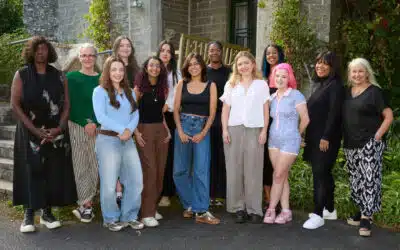
Despite this, Northern Gritstone has backed leading female academics such as Helen Gleeson and prides itself on its own diversity record. Over half of employees at Northern Gritstone are female, including over 50% of its senior executives and the investment team.
“We represent the communities in which we operate. You don’t have unconscious or conscious bias when your team reflects that.”
And over 50% of the people on Northern Gritstone’s newly launched NG Studios accelerator programme are female. .
NG Studios falls under Northern Gritstone’s wider ‘Innovation Services’ umbrella, which supports founders through accelerator and venture building programmes, mentoring on talent and leadership, to scaling advice.
Northern Gritstone is also trying to change what “success” means for a university spinout through its programmes as historically, a spinout was successful if you spun out “irrespective of how much capital” was raised.
“The programmes are deliberately ambitious and aspirational to get on. If you get on the programme, you get £200,000 in funding. Success is then raising £3m to £5m and underpinning a plan that will hopefully lead to a £10m Series A raise.”
So far, there have been around four deep tech cohorts and the first life sciences cohort has gone through NG Studios, with around 30 businesses participating.
“We’ve invested in just over half of those that have completed the programme, and our seed rounds are well above the averages,” he claims.
And the aim is to tackle how some spinouts fail to be funded “properly” at the start of their journey.
“You couldn’t hire well and you couldn’t get what you needed to do, you were being set up for failure rather than success. NG Studios gives you a much better chance of success.”
READ MORE: Venture fund seeks UK’s first trillion dollar business
More recently, Northern Gritstone has collaborated with Parkwalk on the launch of the Northern Universities Venture Fund, a new Enterprise Investment Scheme (EIS) fund offering investors access to early-stage IP-rich science and deep tech investment opportunities from the Universities of Leeds, Liverpool, Manchester and Sheffield.
“I think it’s really exciting, we’re giving people an opportunity on a retail basis to invest in what we’re doing.”
As for the future, the focus is on building momentum.
“We’re earning the right to do more,” he explains. “At the moment, it’s all in the oven baking and I need to take a few of the cakes out and show them to people. We’ve got some absolute stars in the portfolio.”
The team continues to grow, with new hires joining across the company’s four offices in Leeds, Manchester, Sheffield and London.
“We’ve done the initial build, now we’re earning the right to do the next thing. We’ve got stuff that has potential and can turn science into world-class businesses.”