
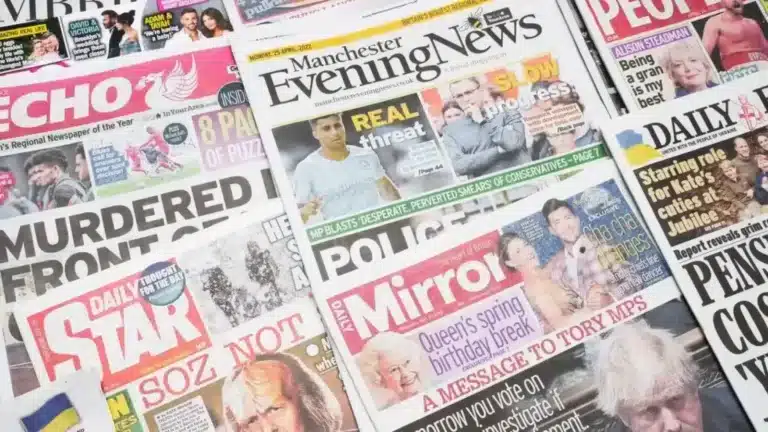

More than 200 editorial jobs and three local newspapers are set to go at Reach plc.
The cuts are the latest in an ongoing series of cuts at the publisher, which most recently saw the axing of a net 186 posts last Autumn in what the company said was it’s “biggest-ever” restructure. Another 80 roles were placed at risk earlier this year.
It is now expected that around 220 journalism jobs will go, with around 60 new ones created, resulting in a net editorial headcount reduction of 160.
The latest round of cuts will also include the closure of three online newsbrands – Aberdeen Live, Galway Beo and Kent Live.
Chief content officer David Higgerson said in an email to staff this morning that the decision was based on the company’s market position in those areas.
Aberdeen Live was launched in July 2021 as a standalone online brand to challenge DC Thomson’s two daily newspapers in the city, the Press & Journal and the Evening Express.
Kent Live covered an area where Reach already had established newspaper brands, but was up against a strong competitor in the shape of Iliffe Media’s Kent Online.
It is understood that the areas set to be hardest hit by the job cuts are the group’s national titles, including The Mirror, Star and Express, its central editorial functions, and its regional titles in the South East and West Midlands.
The publisher’s “heartlands” in Manchester, Liverpool, Wales, the North East and the East Midlands will be less impacted, it is understood.
Higgerson said in his email: “We are in the middle of a mammoth shift in how audiences want content and journalism. To ensure a sustainable future for our journalism, we must focus our investment in the areas where our audiences spend the most time and where our revenue reflects the value of our work.
“In our newsrooms, that means less emphasis on story volume and more on original journalism and distinctive brands. It also means that ‘active engaged time’ will become our north star metric, over and above page views, by the end of the year.
“Our page view decline has been driven primarily by a decline in Google referrers. Locally, we continue to be challenged by an expansionist BBC, whose local output mirrors what is already being created by publishers up to 70% of the time.
“These headwinds, and others which also affect the whole industry, mean that we need to make these changes while also reducing our overall costs.
“I, along with the editorial senior leadership team, have reduced a range of non-people budgets in order to protect as many jobs as possible, but the scale of the challenge facing our wider industry is such that we have to enter next year a smaller editorial organisation.
“Today’s proposals mean that we are removing approximately 220 roles from our editorial structure, while at the same time creating more than 60 editorial roles.
“The roles being created are ones which are needed to drive digital revenue growth, particularly in subscriptions and in longer-form video, and enhance brand reputation through well-read journalism which creates loyalty.
“We are also taking the difficult decisions to close three titles: KentLive, AberdeenLive and GalwayBeo. This is not a reflection of the work done on these titles, or the commitment of the journalists on them. The decision is based on our market position in these areas.
“In almost every market we operate in, locally, we are the dominant publisher, even after the page view declines we have seen this year.
“This is not the case in these three markets, which is why we are taking the decision to exit them, while focusing efforts on the markets where we make the greatest impact.”
The fresh bout of cost-cutting was foreshadowed by chief executive Piers North, pictured, in his report accompanying the company’s half yearly results published in July.
He added: “Our decisive cost actions in 2025 and continued cost focus resulted in adjusted operating costs declining by 10%, and we expect to drive a similar level of savings across the second half of the year.
“This will include reductions to some teams, as well as other savings such as third-party contracts, including the lower print production volumes.”