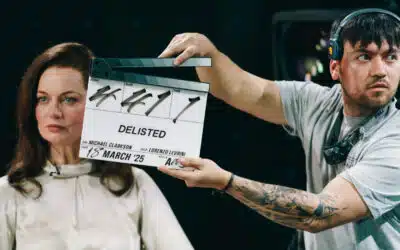


Space Digital has delivered Delisted, a 28-minute short film for the Future of Life Institute, taking it from production through to finished visual effects entirely in-house at MediaCityUK.
It is written and directed by Michael Patrick Clarkson, produced by Matt Nelson, with visual effects led by Simon Blackledge and photography by Lorenzo Levrini. It is released today (October 6) on Omeleto.
Delisted is part of the Institute’s wider campaign for stronger controls on artificial intelligence, a debate that has moved rapidly into the political mainstream. The film arrives three weeks after the Institute’s Pro-Human Assembly in Washington DC, which brought together more than 650 people, with speakers ranging from Senator Bernie Sanders to Steve Bannon, and drew international news coverage. Matt Nelson and Simon Blackledge attended as guests of the Institute.
Set in the near future, it imagines a world in which artificial intelligence has taken so many people’s jobs that protests break out, and a government responds by removing anyone who objects from every digital system they rely on: their bank accounts, their phones, their identification, their medical and employment records. They are still alive. They simply no longer exist as far as the state is concerned.
The film follows a teacher, a truck driver and a journalist whose jobs have already been lost to automation, and who then find themselves erased altogether.
Delisted opens in a computer-generated environment. Both trucks, the church and the city behind them are CG, created by the VFX department at Space Digital, alongside further environment work throughout the film.
The second major sequence is the one that occupies the least screen time. The audience gets a glimpse behind APPOLLO, the calm text-only interface SYB1L presents to the world, and sees the true processes of the AI system at the centre of the film. It is on screen for only five seconds, but took over six weeks from concept to completion.
“One of the most time-consuming motion graphics sequences in the film is about five seconds long,” said Simon Blackledge, head of post at Space Digital. “We see behind APPOLLO, SYB1L’s calm, elegant, text-only user interface, and it had to do two things at once. It had to look like something a real system would be running, and it had to be readable enough that an audience understands what it is doing to people while it is on screen. A month went on the concept design alone. Most of the intricacies the audience will never register, but if those details were not there, the whole premise of the film would have felt fake.”
Delisted was shot anamorphic, which shaped the visual effects and motion graphics work as much as the photography. Every element had to be built and finessed to match the anamorphic footage.
“Delivering a 28-minute drama of this ambition on this schedule only works because everything happens under one roof,” said Matt Nelson, producer and co-founder of Space Digital. “Production, post and VFX are not three separate conversations here, they are one. Shots were designed knowing exactly what could be achieved downstream, which removes the handover points where time and budget usually go.”
The film was shot over three days and one night in March 2026, with a cast of more than 20 actors and around 100 extras, at Holy Trinity Church in Blackburn, Ribblesdale High School in Clitheroe and an office building on Oxford Road in central Manchester, with further filming in Barrowford, Lancashire and at Recode XR Studio in Manchester.
It was shot on Arri 35 with anamorphic lenses by director of photography Lorenzo Levrini, whose recent features include Wasteman, which premiered at the 50th Toronto International Film Festival and won five BIFAs, and The Kidnapping of Arabella, which premiered at Venice.
“Michael and I had worked in anamorphic together before and we felt it was the right format to tell this story. In the collective cultural consciousness, viewers still associate anamorphic with the golden age of science fiction cinema: Blade Runner, Close Encounters and so on,” said Levrini.
“We were making a film that warns against the dangers of AI, so we felt it appropriate that the photography have a human character and texture, and given that we were shooting digital, the poetic distortion of anamorphic was the perfect way to achieve this.
“Shooting anamorphic always proves more of a challenge with VFX, but Space were amazing at making it work and I’m very proud of the result.”
Delisted stars Jamie Bamber and Katie Parker, with Alex Bhat, Rosalind Halstead, Charlie Hiscock and Ruby Bridle, who wrote and performs the film’s original song, Bleed Us Anew.
Michael Patrick Clarkson, the film’s writer and director, said: “I started where I always start, with people. The teacher replaced by a machine shaping the minds of the next generation. The truck driver whose livelihood will be automated away. The journalist who can no longer speak because his truth is a threat. These are the people society leans on without acknowledging, and they are the first to fall,.”
He added: “But Delisted is not a film without hope. The human spirit is not something AI can touch, replicate or erase.”
The Future of Life Institute is a non-profit working to reduce large-scale risks from transformative technologies, with a particular focus on the risks posed by artificial general intelligence. It commissioned Delisted as part of its ongoing work to bring the conversation about AI’s impact to wider public audiences, an approach it has pursued through film since Slaughterbots in 2017.
Delisted is the third film Space Digital has made for the organisation, following Slaughterbots in 2017 and Slaughterbots: if human, kill () in 2021.
Delisted is released alongside Moloch, a second Future of Life Institute short directed by Tom Cozens with Owl In Space, which released on Omeleto on 29 September.
Watch Delisted in full on Omeleto now.
Or find out more information about the film here.